
The Cayman Islands may look like paradise, but behind the palm trees and turquoise waters sits one of the world’s most fascinating economies. As a British Overseas Territory, the Caymans are not fully independent—they rely on the UK for defense and foreign affairs—but they enjoy broad self-governance in domestic policy.
This unique status, paired with low taxes and financial openness, has turned the islands into a global financial hub. The Cayman Islands economy is disproportionately influential: while the territory has fewer people than many suburbs, it plays a starring role in international finance.
1. More Businesses Than Residents
The Cayman Islands has a population of about 70,000 people. Yet more than 110,000 businesses are registered there. That’s a rare case where companies outnumber residents.
These aren’t just shell companies. Hedge funds, insurance firms, subsidiaries of Fortune 500 multinationals, and thousands of investment vehicles are domiciled here. Cayman’s legal system—rooted in English common law—combined with stable regulation makes it a trusted hub. For comparison, the U.S. has about one business for every 11 people. In Cayman, it’s the reverse—1.6 businesses for every resident.
2. Zero Income and Corporate Taxes
Perhaps the single most defining feature of the Cayman Islands economy is its tax structure. There’s no:
-
Personal income tax
-
Corporate income tax
-
Capital gains tax
Instead, revenue is raised from fees, permits, and import duties (covered below). For global investors, this creates a low-friction base to structure funds or subsidiaries.
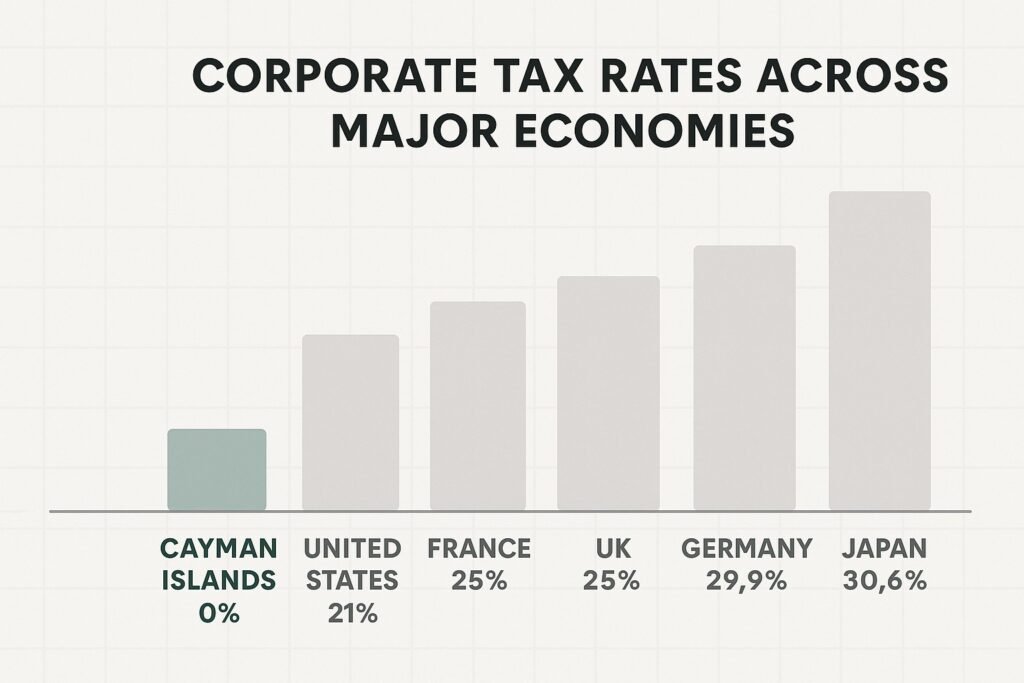
Contrast that with the U.S. corporate tax rate of 21% or France at 25%. The gap explains why Cayman consistently appears on lists of top offshore financial centers.
3. GDP vs. Income Per Capita
On paper, the Cayman Islands looks like one of the richest places on earth. Its GDP per capita is about $90,000, ranking in the global top 15–20.
But here’s the nuance: income per capita (average personal income) is closer to $60,000. That’s still high—well above the U.S. median of ~$45,000—but much lower than the GDP figure suggests.
Why the gap? GDP per capita reflects the total value of economic activity divided by population. Cayman hosts trillions in assets and financial flows, inflating GDP. But not all of that value translates into resident incomes. In short, the islands’ role as a financial conduit lifts GDP statistics far more than household earnings.
4. Financial Services as the Engine
Financial services are the backbone of the Cayman Islands economy, accounting for roughly 40% of government revenue and more than half of GDP.
-
Cayman is the second-largest domicile for hedge funds worldwide, with over 27,000 registered funds.
-
It also serves as a global hub for structured finance, captive insurance, and trusts.
-
The Cayman Islands Monetary Authority (CIMA) ensures regulation and credibility, making it less of a “wild west” than the tax-haven stereotype suggests.
This system doesn’t just serve Cayman. U.S. pension funds, Canadian insurers, and European asset managers all channel money through Cayman vehicles. It’s a crucial node in global finance.
5. A Surprising Player in U.S. Debt
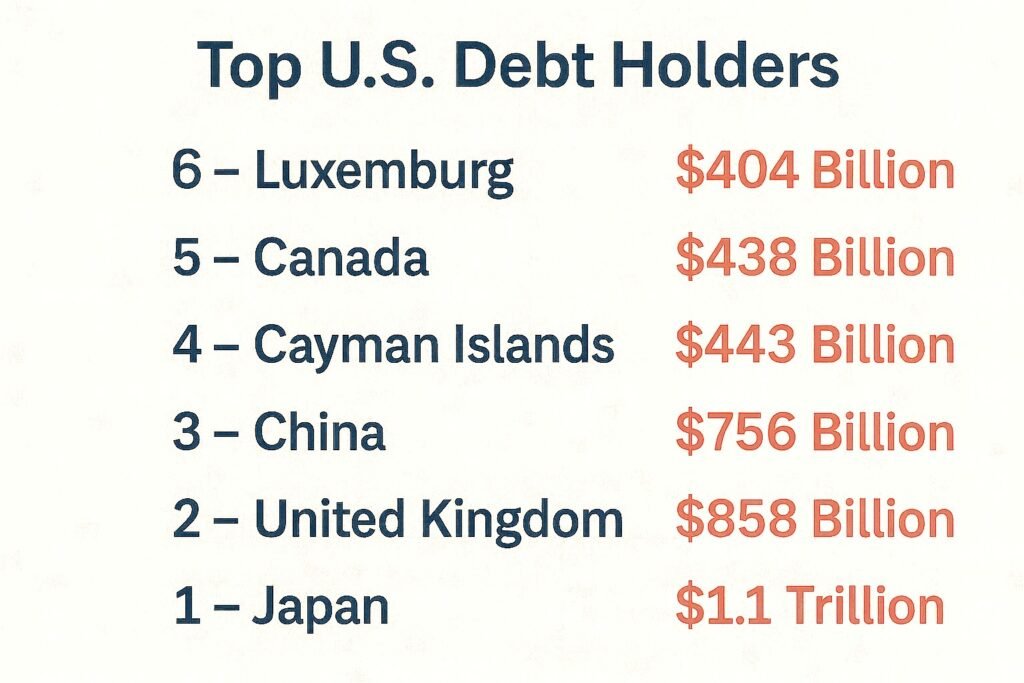
Here’s a stat that turns heads: the Cayman Islands is consistently among the top foreign holders of U.S. Treasuries, with about $443 billion in holdings.
For context:
-
Japan: ~$1.1 trillion
-
United Kingdom: ~$858 billion
-
Cayman Islands: ~$443 billion
-
Canada: ~$438 billion
That’s remarkable for a territory smaller than most U.S. counties. Importantly, this isn’t the Cayman government stockpiling debt—it’s global investors using Cayman-based custodians. Still, it shows how central the territory is to financing the U.S. government.
6. Import Duties Fund the Government
With no income or corporate taxes, the Cayman government depends heavily on customs and import duties, which make up a major share of “coercive revenue.”
Almost everything is imported—food, fuel, cars, even construction materials. Tariffs are high:
-
Vehicles: 22%–42% import duty
-
Alcohol and tobacco: steep duties to discourage overuse while raising revenue
-
Luxury goods: taxed at higher rates than essentials
As a result, consumer prices are higher than in the U.S. But for Cayman, this model ensures the government remains solvent without direct taxation.
7. Tourism: The Other Pillar
Tourism is the second major pillar of the Cayman Islands economy, contributing around 25% of GDP and employing thousands.
Highlights include:
-
Seven Mile Beach, one of the Caribbean’s most famous stretches of sand
-
World-class diving and snorkeling
-
Luxury resorts and high-end cruise tourism
Tourism makes Cayman more vulnerable to external shocks. For instance, during the COVID-19 pandemic, visitor arrivals collapsed by 75%, forcing the government to lean even harder on financial services. Still, the sector has rebounded, with luxury tourism positioning the islands at the top of the Caribbean market.
8. Looking Beyond Finance and Tourism
To diversify, the Cayman Islands is exploring new frontiers:
-
Medical tourism: New facilities like Health City Cayman Islands are attracting overseas patients.
-
Fintech & blockchain: Leveraging its finance reputation, Cayman is experimenting with crypto-regulation.
-
Renewable energy: Projects aim to reduce dependence on imported fuel.
The workforce is highly international—over half of employees are expatriates, hailing from more than 130 countries. This global talent base supports Cayman’s ability to adapt quickly.
Conclusion
The Cayman Islands economy is a masterclass in how a small territory can wield outsized influence. With more companies than people, a GDP per capita of $90,000 versus income per capita of $60,000, and a central role in global finance and U.S. debt, the islands prove that size doesn’t determine power.
For the UK, Cayman isn’t just a sunny overseas territory—it’s a strategic economic asset, quietly steering billions (if not trillions) through its financial system.
Next time you see Cayman on a list of U.S. debt holders or hear the word “tax haven,” remember: behind the beaches lies one of the most important hubs in the global financial web.