Venezuela’s economic collapse stands as one of history’s most baffling disasters. Venezuela sits on 303 billion barrels of oil, the world’s largest proven reserves.[1] Beyond that, the country holds 8,000 tons of gold underground (although not verified) and possesses enough natural gas to power Latin America for decades.[2] Yet in 2024, the average Venezuelan earns less than $4,000 per year, while prices rise faster than almost anywhere on Earth. Since 2015, roughly 7.7 million people have fled the country.[3]
The economic collapse of Venezuela reveals what happens when a resource-rich nation systematically destroys every mechanism that turns natural wealth into actual prosperity. Ultimately, resources don’t make you rich. Management does.
Here’s what went wrong and why it matters beyond Venezuela’s borders.
The Economy That Vanished
How Venezuela Lost Three-Quarters of Its GDP
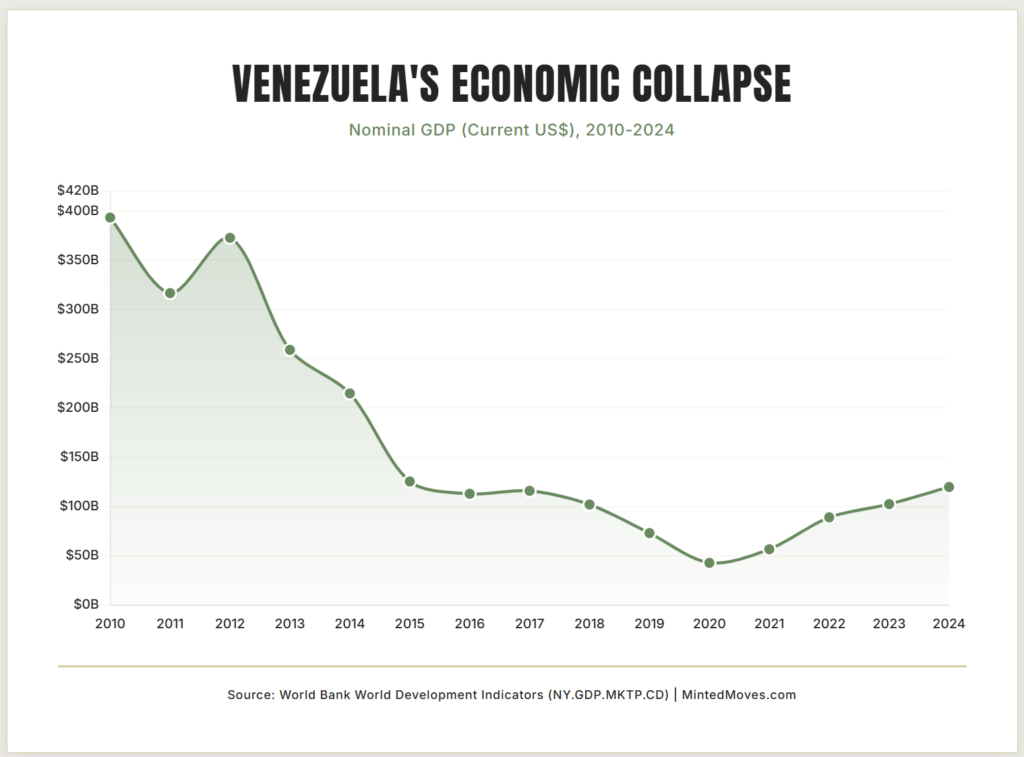
Between 2014 and 2021, the Venezuela economic collapse erased 75% of the country’s GDP.[3] To understand that scale, consider this comparison: the Great Depression, history’s benchmark for economic disaster, saw GDP fall 30% in the United States. In contrast, Venezuela’s collapse was two-and-a-half times worse without a world war, natural disaster, or external invasion.
The country’s GDP fell from roughly $240 billion in 2014 to barely $90 billion in 2023.[4] As a result, Venezuela’s entire economy is now smaller than El Salvador’s, despite having six times the population and resources that dwarf Central America’s reserves. Moreover, GDP per capita tells an even grimmer story about the Venezuela’s economic collapse.
The Personal Wealth Wipeout
Venezuelans earned over $10,000 per person in 2012. However, by 2020, that figure had cratered to approximately $1,700, representing an 83% wipeout of personal wealth in under a decade.[5] Even after a modest recovery, per capita income hovers around $3,500. Consequently, the average Venezuelan has lost 65% of their purchasing power since the crisis began.
Think about that for a moment: two-thirds of your savings, your salary, your net worth, simply vanishing over ten years while you watch helplessly. The Venezuela economic collapse didn’t happen overnight. Rather, it was a slow-motion train wreck decades in the making, accelerated by policy mistakes that compounded into catastrophe.
Understanding how it unfolded requires looking at the specific mechanisms that failed, starting with the currency itself.
The Currency Nobody Wants
When Money Becomes Worthless
In 2018, Venezuela’s inflation peaked at 130,000% annually, cementing the Venezuela economic collapse as one of history’s worst hyperinflation episodes.[3] Prices doubled every few weeks. For instance, a cup of coffee that cost 1,000 bolívares on Monday cost 2,000 by the following Monday. By month’s end, it was 8,000.
The government’s response was to remove zeros from the currency. Specifically, fourteen of them, across three separate redenominations between 2008 and 2023.[3] Therefore, one bolívar today equals 100 trillion pre-2008 bolívares. This isn’t just currency devaluation. Instead, it’s currency obliteration, the kind of monetary destruction that erases generational wealth and destroys trust in financial institutions for decades.
The Dollar Takes Over
Walk through Caracas today, and you’ll see the result of the Venezuela economic collapse at street level. Street vendors quote prices in U.S. dollars. Similarly, grocery stores display shelf tags in dollars. Real estate transactions, car sales, and restaurant bills are all settled in greenbacks. Currently, an estimated 60 to 70% of transactions occur in foreign currency, creating what economists call de facto dollarization.[6]
The bolívar hasn’t been formally abolished. In fact, the government still prints it, still sets official exchange rates, still requires some transactions to use it. Nevertheless, Venezuelans have voted with their wallets, and the verdict is clear: nobody trusts it. When a nation abandons its own currency without officially doing so, you know the economic collapse has reached the deepest level of dysfunction.
How Oil Wealth Became Oil Poverty
Venezuela’s economic collapse is particularly tragic because it happened to a nation sitting on a fortune. Venezuela’s 303 billion barrels should be a national treasure. Instead, they’re a cautionary tale about the difference between reserves and production, between potential and reality.
In the late 1990s, Venezuela pumped 3 million barrels per day.[1] Today, however, production limps along at roughly 750,000 barrels daily, a 75% decline.[7] Remarkably, Venezuela now pumps less than Angola, despite holding ten times the reserves. This production collapse sits at the heart of the Venezuela economic collapse because oil revenues fund approximately 58% of the government budget.[7]
Why Production Collapsed
The culprit is technical, not geological. Venezuela’s oil is extra-heavy crude from the Orinoco Belt, tar-like oil that requires special upgrading facilities and diluents to transport and refine. When oil prices were high in the 2000s, the state oil company PDVSA had cash to maintain these complex operations. Then came underinvestment, corruption, and an exodus of skilled engineers who saw the Venezuela economic collapse coming and left while they could.[10]
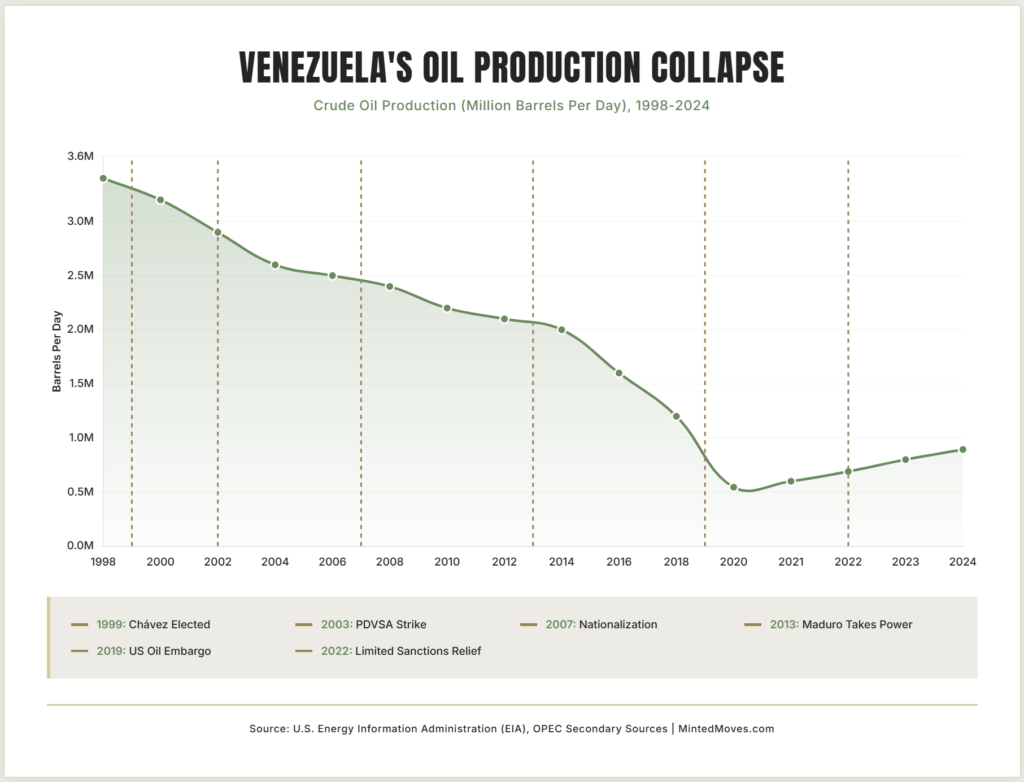
By 2023, critical infrastructure had decayed to the point of failure. Upgraders that once converted heavy crude into exportable oil now sit idle or operate far below capacity. Meanwhile, power outages in oil regions shut down pumps for hours or days at a time. Additionally, a chronic shortage of diluents means wells produce crude that can’t be moved through pipelines without special treatment that Venezuela can no longer afford or organize.[10]
Burning Wealth While Citizens Go Without
Venezuela also burns approximately 700 billion cubic feet of natural gas annually, lighting up oilfields in spectacular flares visible from space.[10] That volume could power every home in Peru for a year. Yet simultaneously, Venezuelans wait in lines for hours to get cooking gas cylinders because domestic gas distribution has collapsed. Thus, the Venezuela economic collapse created this absurd situation where the country burns enough energy to power a nation while its own citizens can’t cook dinner.
The technical breakdown tells only part of the story. Furthermore, corruption hollowed out PDVSA from within. A 2023 internal audit found billions in oil revenues missing or stolen, siphoned off by officials who treated the national oil company as a personal piggy bank. When your oil industry becomes a criminal enterprise rather than a revenue generator, economic collapse becomes inevitable.
The Illicit Trade Stealing Venezuela’s Gold
While oil drove the Venezuela economic collapse, gold reveals how the country lost control of its resources entirely. Venezuela’s government claims the southern Orinoco Mining Arc contains 8,000 tons of gold.[13] However, reality is messier and darker than any official statistic.
Illegal mining operations run by Colombian guerrilla groups like the ELN, Venezuelan criminal gangs, and corrupt military officials control vast swaths of the mining territory. Approximately 20 to 30 tons of gold get extracted annually from these chaotic, lawless zones. How much reaches Venezuela’s Central Bank through official channels? About 2 tons, roughly 14% of total production.[13]
Where the Stolen Gold Goes
The remaining 86% vanishes into smuggling networks that span continents. Gold leaves Venezuela through clandestine flights to Uganda, Turkey, and the UAE. Alternatively, it crosses porous borders into Colombia and Brazil where it enters international markets with laundered paperwork. Some estimates suggest more Venezuelan gold flows through Dubai’s refineries than through Venezuela’s official export channels, a shadow economy operating in plain sight while the government pretends to control the resource.
The Human Cost of Illegal Mining
The human cost deepens the Venezuela economic collapse beyond mere statistics. Illegal mining has created what locals call a wild west in southern Venezuela, lawless zones where mercury poisoning contaminates rivers that indigenous communities depend on for drinking water and fishing. Violence is routine. Moreover, environmental devastation rivals illegal Amazon deforestation in scale and permanence.
Venezuela has resources in abundance. It just doesn’t control them, can’t tax them, can’t use them to fund public services or infrastructure. When 86% of a major resource extraction industry operates outside government control, you don’t have an economy. Instead, you have organized looting with a thin veneer of state authority painted over the top.
When a Quarter of a Nation Leaves
The Venezuela economic collapse forced an exodus on a scale rarely seen outside war zones. Since 2015, 7.7 million Venezuelans have fled their country, one of the largest displacement crises in modern history that rivals Syria’s exodus during the civil war.[14] Colombia hosts 2.5 million refugees. Additionally, Peru has 1.5 million. Over half a million have reached the United States through increasingly dangerous migration routes.
Losing the Skilled Workforce
These aren’t all desperate masses with no skills or education. Rather, the Venezuela economic collapse is hemorrhaging the country’s skilled workforce, the very people needed to rebuild a functional economy. Hospitals operate without enough physicians because doctors earn $10 per month in bolívares and have left for Colombia or Chile where they can actually support their families. Oil companies can’t find experienced petroleum engineers because they’ve all relocated to Houston, Bogotá, or Madrid.
The Remittance Economy
The irony cuts deep when you understand Venezuela’s history. In fact, the country once attracted immigrants from across Latin America during its oil boom years in the 1970s and 1980s. Colombians, Ecuadorians, and Argentinians came seeking opportunity in what was then South America’s richest nation. Now the flow has reversed completely, and Venezuela has become the region’s primary source of economic refugees fleeing a collapse that destroyed the middle class.
Remittances tell the story from the other side of the Venezuela economic collapse. Venezuelans abroad sent home over $2.5 billion in 2023, money that props up families who can’t survive on local wages.[15] For many households, a relative in Miami or Lima sending $200 monthly through Western Union means the difference between eating and starvation. Consequently, the country now depends on the earnings of people who left because the country failed them.
Why Recovery Will Take Decades
The brain drain compounds every other problem in the Venezuela economic collapse. How do you rebuild an oil industry without petroleum engineers? How do you reform institutions without qualified civil servants willing to work for worthless salaries? How do you restart manufacturing without skilled technicians who haven’t already emigrated? The short answer is you can’t, which is why recovery will take decades even under the best circumstances.
The Geopolitical Ripple Effects
The Venezuela economic collapse created a vacuum that global powers rushed to fill, turning a domestic disaster into an international chess match. China lent over $50 billion in oil-for-loan deals dating back to 2007, securing discounted crude in exchange for infrastructure investments that never fully materialized as Venezuela’s production fell.[16] Meanwhile, Russia’s Rosneft took stakes in multiple oil joint ventures, giving Moscow a strategic foothold in the Western Hemisphere at minimal cost.[16]
How U.S. Sanctions Accelerated the Collapse
The United States watched from the sidelines initially, then imposed sanctions that accelerated Venezuela’s economic collapse rather than solving it. Financial sanctions in 2017 cut Venezuela off from U.S. debt markets, making it impossible to refinance or restructure obligations. Subsequently, oil sanctions in 2019 banned American companies from buying Venezuelan crude, eliminating the country’s largest customer overnight.[16] The stated goal was to pressure regime change through economic pain. However, the result was accelerated collapse and deeper dependence on China and Russia, the opposite of the intended effect.
Regional Spillover Effects
Cuba lost its lifeline as Venezuela’s economic collapse deepened. For years, Venezuela shipped subsidized oil to Havana as part of the PetroCaribe program, essentially free energy in exchange for political alignment and Cuban doctors working in Venezuelan clinics. When Venezuela’s production cratered below 1 million barrels per day, maintaining these giveaways became impossible. As a result, Cuba’s already fragile economy suffered another blow, and the knock-on effects rippled across Caribbean nations that relied on Venezuelan oil assistance to manage their energy costs.
The Migration Crisis Goes Regional
The migration crisis became a regional problem that transformed politics across Latin America. Colombia struggled to absorb millions of Venezuelans while managing its own peace process with armed groups. Similarly, Peru, Ecuador, and Chile saw Venezuelan populations swell in their cities, straining social services and creating political backlash. At the U.S. southern border, Venezuelan asylum seekers became the fastest-growing nationality by 2023, injecting the Venezuela economic collapse directly into American domestic politics and immigration debates.
Venezuela’s failure didn’t stay contained within its borders. Instead, it metastasized across the hemisphere, creating refugee flows, empowering adversaries of the United States, and demonstrating how quickly institutional collapse in one country can destabilize an entire region. Therefore, the Venezuela economic collapse is a regional crisis, not just a national one.
What Comes Next
Scenario 1: Muddle-Through Stabilization
Three futures emerge from the wreckage of the Venezuela economic collapse, each with different probabilities and implications for recovery. The muddle-through scenario sees Venezuela continuing its current trajectory of partial recovery with persistent problems. Oil production inches toward 1 million barrels daily by 2027 as companies like Chevron gradually invest under clearer sanctions exemptions. Meanwhile, inflation remains high but manageable at 50 to 100% annually through continued dollarization that the government tacitly accepts.
GDP grows 2 to 4% yearly, slowly climbing from the abyss but never restoring 2013 levels.[17] Migration slows but doesn’t reverse as the brain drain becomes permanent. Furthermore, political gridlock prevents major reforms. This is the likeliest outcome, not catastrophic but far from prosperity.
Scenario 2: The Renaissance
The renaissance scenario requires everything to go right. A political transition brings reformist leadership and full sanctions relief. Consequently, foreign investment floods in, perhaps $10 to 15 billion over five years to rehabilitate oil infrastructure. Production reaches 2 million barrels daily by 2030. Additionally, debt restructuring with China and bondholders unlocks international credit markets.
GDP surges 10% annually for several years as commerce and oil rebound.[18] Some Venezuelan expats return, drawn by opportunity. Poverty falls below 30%. Thus, the country rejoins the global economy as a functioning petrostate. This requires political change, investment commitment, and sustained effort, making it low probability but not impossible.
Scenario 3: Failed State Spiral
The failed state scenario represents the nightmare version of the Venezuela economic collapse. Political instability triggers internal conflict between rival factions. Oil facilities suffer sabotage or war damage. As a result, production collapses below 300,000 barrels daily. Hyperinflation returns with a vengeance. Another 2 to 3 million people flee within months, overwhelming neighbors.
Venezuela fragments into zones controlled by different groups: military units, militias, criminal networks operating with impunity. The humanitarian crisis surpasses Syria’s peak, and international intervention becomes unavoidable. This is what keeps regional leaders awake at night.
The Lesson: Resources Are Not Destiny
Why Geology Doesn’t Guarantee Prosperity
The Venezuela economic collapse demolishes a comfortable myth that countries with natural resources will inevitably prosper. Prosperity requires competent institutions, property rights, rule of law, and economic freedom. Take those away, and even 303 billion barrels of oil become worthless, trapped underground while people above ground starve.
The Pattern Repeats Globally
The lesson extends well beyond Venezuela to resource-dependent nations worldwide facing similar pressures. Nigeria, with massive oil reserves, struggles with comparable challenges of corruption and underinvestment. Similarly, Iraq’s oil wealth hasn’t translated to broad-based development despite decades of production. Even Russia, with vast energy resources, faces the resource curse through institutional weakness and corruption that prevent resources from generating sustainable prosperity.
Venezuela represents the extreme case, but the pattern appears universal across continents and cultures. Geology creates opportunity, but governance determines whether that opportunity translates into development or disaster.
The Bottom Line
Venezuela demonstrates the limits of sanctions as a tool for regime change and the danger of resource dependence without diversification. It shows how corruption can hollow out institutions faster than reforms can rebuild them. Furthermore, it proves that migration becomes inevitable when economic collapse destroys the social contract between government and citizens.
The richest poor country on Earth isn’t an anomaly or a statistical outlier. Instead, it’s a lesson in how not to manage an economy, written in the suffering of millions who deserved better from their leaders and their resources. The Venezuela economic collapse will be studied in economics courses for generations as a case study in institutional failure, resource mismanagement, and the critical importance of governance over geology.
References
[1] U.S. Energy Information Administration — Country Analysis Brief: Venezuela — November 2024. Available at: https://www.eia.gov/international/content/analysis/countries_long/Venezuela/pdf/venezuela_2024.pdf
[2] El País — Oil, gold and rare earth elements: the backdrop to US political tension with Venezuela — December 22, 2025. Available at: https://english.elpais.com/international/2025-12-22/oil-gold-and-rare-earth-elements-the-backdrop-to-us-political-tension-with-venezuela.html
[3] Council on Foreign Relations — Venezuela: The Rise and Fall of a Petrostate — January 2024. Available at: https://www.cfr.org/backgrounder/venezuela-crisis
[4] International Monetary Fund — República Bolivariana de Venezuela: At a Glance — December 2025. Available at: https://www.imf.org/en/countries/ven
[5] Americas Quarterly — Venezuela: A 2025 Snapshot — January 14, 2025. Available at: https://www.americasquarterly.org/article/venezuela-a-2025-snapshot/
[6] Misión Verdad — Venezuela’s Economy in 2023: Growth, Devaluation and Wages — 2024. Available at: https://misionverdad.com/english/venezuelas-economy-2023-growth-devaluation-and-wages
[7] Reuters — Exclusive: Venezuela to receive 27% more income from PDVSA after sanctions easing — December 12, 2023. Available at: https://www.reuters.com/markets/commodities/venezuela-receive-27-more-income-pdvsa-after-sanctions-easing-document-2023-12-12/
[8] Reuters — What’s the status of international oil companies in Venezuela after Maduro’s capture? — January 5, 2026. Available at: https://www.reuters.com/business/energy/whats-status-international-oil-companies-venezuela-after-maduros-capture-2026-01-05/
[9] Americas Quarterly — Venezuela: The Post-Maduro Oil, Gas and Mining Outlook — 2024. Available at: https://www.americasquarterly.org/article/venezuela-the-post-maduro-oil-gas-and-mining-outlook/