

Turkish households are sitting on $500 billion in gold. That’s roughly six times what all Turkish banks hold combined.[1]
However, this staggering hoard isn’t hidden from authorities—it’s an open secret. In Turkey, Gold sits in home safes, under mattresses, worn as jewelry, passed through generations. Moreover, Turks are increasingly layering cryptocurrency on top, making Turkey one of the world’s leading crypto markets.[2]
So why do millions of people hold so much gold, and why are they leading in crypto adoption? The answer lies in three decades of repeated currency failures that taught Turkish households a brutal lesson: savings kept in lira can evaporate overnight.
This is the story of how Turkey built a parallel financial system—and what it reveals about the future of money when trust collapses.
How Trust in the Lira Collapsed
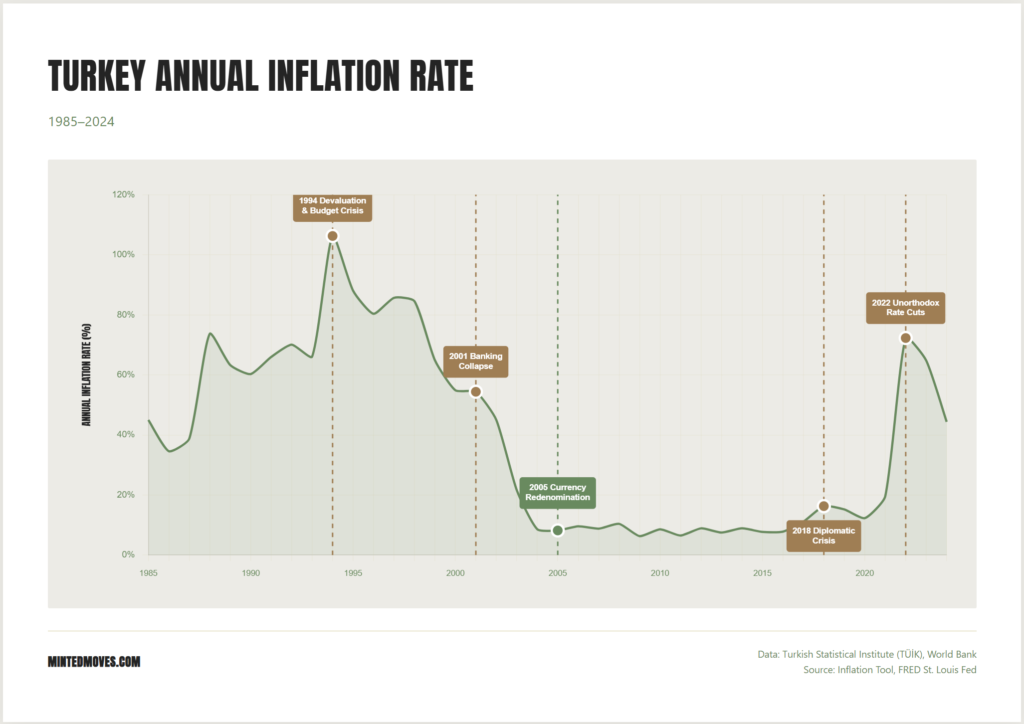
Turkey’s relationship with its currency is defined by crisis. In fact, four major shocks over thirty years destroyed confidence in the lira as a store of value.
1994: The First Breaking Point
Turkey’s economy was overheating in the early 1990s. The government had been financing infrastructure projects and state enterprises beyond its tax revenue, creating persistent budget deficits. To cover these shortfalls, authorities resorted to printing money.[3]
This monetary expansion pushed inflation to chronic levels of 70-80%. The mounting debt burden and inflationary pressures eventually spooked foreign investors, who began withdrawing capital rapidly. As a result, the government was forced to devalue the lira by approximately 50%. Annual inflation topped 100%.
For ordinary Turks, this meant their purchasing power was cut in half. Specifically, a month’s salary suddenly bought two weeks of groceries.
2001: When Banks Failed
If 1994 was a warning, 2001 was catastrophe. In February, a public confrontation between President Ahmet Necdet Sezer and Prime Minister Bülent Ecevit during a National Security Council meeting signaled deep political dysfunction. The president threw a copy of the constitution at the prime minister during a dispute over corruption and banking regulation.[4]
Markets interpreted this as evidence that Turkey’s government couldn’t implement necessary reforms or maintain economic stability. The political chaos suggested that weak banks would remain unregulated and debts would continue mounting. Consequently, foreign investors fled.
The central bank attempted to defend the lira by using its foreign currency reserves to buy lira in the market—essentially trying to create artificial demand to prop up the exchange rate. However, this strategy burned through billions of dollars before authorities finally abandoned the fixed exchange rate system and let the market determine the lira’s value.[5]
When they let the lira float freely, it lost about 40% of its value within weeks. Furthermore, over a dozen banks collapsed or were nationalized. GDP contracted by 5.7%—the worst recession in modern Turkish history.[6]
But the statistics don’t capture the real damage. Indeed, many Turks saw their bank deposits become inaccessible as institutions were restructured. Families lost life savings not to poor investment, but to systemic failure.
The lesson was clear: banks can’t protect you when the entire system breaks.
2005: A Reset That Didn’t Erase Memory
By 2005, the government attempted a fresh start. They redenominated the currency, dropping six zeros. In other words, one million old lira became one new lira. This change came alongside a bailout program from the International Monetary Fund, which provided billions in loans conditional on Turkey implementing fiscal discipline and banking sector reforms.[7]
Combined with these IMF-backed reforms, inflation dropped below 10% and Turkey enjoyed genuine economic growth through the late 2000s. The new currency looked credible.
However, people remembered. Institutional reforms didn’t fundamentally change underlying habits—deficit spending, political interference in monetary policy, weak regulation. Thus, the prosperity of the 2000s didn’t erase what came before. It postponed the next crisis.
2018-2022: Currency Chaos Returns
The fragility returned with force. In 2018, tensions escalated between Turkey and the United States over the detention of American pastor Andrew Brunson on terrorism charges. The U.S. imposed sanctions on Turkish officials, and President Trump threatened additional tariffs. The diplomatic standoff triggered a crisis of confidence in Turkish markets.[8]
The lira plummeted 30% in weeks. Markets stabilized briefly after Brunson’s release, but real turbulence began in 2021.
President Erdoğan, pursuing unorthodox economic theory, pressured the central bank to cut interest rates despite accelerating inflation. When central bank governors resisted, they were fired—three different governors in two years.[9]
As a result, the lira fell 44% against the dollar in 2021 alone. By late 2022, inflation hit 85.5%—a level not seen since 1998.[10] From 2020 to 2024, the lira lost roughly 80% of its value against the dollar.[11]
For Turkish households, this wasn’t abstract policy. Rather, it meant watching grocery bills double, rent surge, and savings evaporate month after month.
Why Turkey’s Gold Is The Foundation of Trust
When your government’s money fails you four times in thirty years, you stop treating it as a store of value. Instead, you look for something the government can’t devalue with a policy announcement.
For Turks, that something is gold.
A Cultural Institution
Gold in Turkey isn’t just investment—it’s woven into social fabric. At traditional Turkish weddings, guests commonly give gold as gifts—coins and jewelry that are pinned or presented to the couple.[11] Similarly, when a baby is born, families often give small gold bracelets or coins as gifts—establishing savings in physical form from the start.
This tradition has practical roots. For centuries, gold was the only asset that reliably held value through Ottoman currency debasements, wars, and political upheavals. Therefore, the habit persisted because the need never disappeared.
The Scale Is Staggering
Turkish households hold roughly 5,000 tons of gold—worth approximately $500 billion.[12] To put that in perspective:
- It’s six times the gold held in Turkish bank deposit accounts
- Moreover, it’s several times Turkey’s central bank reserves (about 800 tons)
- Per capita, Turkey ranks among the highest private gold holders globally[13]
Most remarkably, this gold sits almost entirely outside the formal financial system. It’s in home safes, under mattresses, worn as jewelry. Essentially, families act as their own central banks.
The Grassroots Banking System
Thousands of neighborhood jewelers function as a parallel banking network. Walk into any jewelry shop across Turkey, and you’ll see the daily gold price displayed—quoted in lira per gram. Everyone knows it. The pricing tracks international rates transparently.
Need to convert savings to gold? A jeweler will sell you coins at prices just slightly above the market rate. Conversely, need cash urgently? Bring in your bangles, and they’ll weigh and buy them back within minutes. No appointments, no paperwork.
This instant liquidity and local trust explains why the system persists even as the government tries to formalize gold holdings.
The Government Can’t Bring It In
$500 billion under mattresses represents capital that can’t be taxed, can’t be lent by banks, and can’t power economic growth. Naturally, Turkish authorities have tried for decades to mobilize it.
The efforts have been persistent. Subsequently, the government launched gold-backed bonds in 2017, gold deposit accounts, and systems allowing deposits through jewelers.[14]
The result? Minimal uptake. By 2024, gold in Turkish banks totaled around $46 billion—less than one-tenth of what households keep privately.[15]
The preference for holding physical gold outside the banking system reflects the enduring impact of past financial crises. They remember 2001 when banks collapsed.
Why Turkey’s Crypto Is The Digital Alternative
If gold moves at the speed of a jewelry shop transaction, cryptocurrency is the high-speed digital alternative. Moreover, Turkey has embraced it faster than almost anywhere on Earth.
World-Leading Adoption
Turkey consistently ranks among top crypto markets globally:
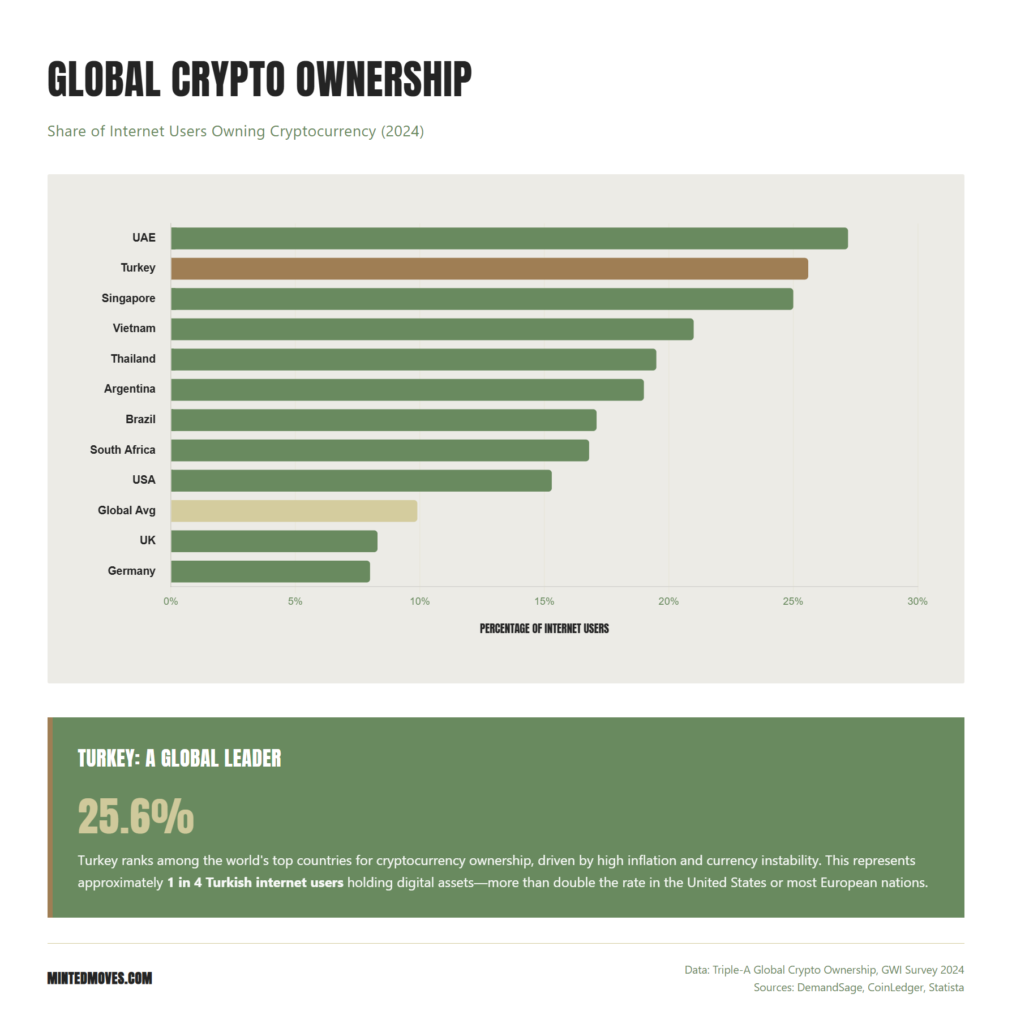
- 27% of Turkish internet users own cryptocurrency—the highest rate worldwide[17]
- Furthermore, some surveys suggest over 50% of adults aged 18-60 have invested in crypto[18]
- The Turkish crypto market generates an estimated $2.2 billion annually[19]
This isn’t just young tech enthusiasts. In fact, among Turkish women aged 18-30, 47% have invested in crypto. Even among women over 45, the figure is 37%.[20] When inflation hits everyone, solutions spread across demographics.
The Lira-Crypto Correlation
The data shows a clear pattern: during periods of lira weakness, crypto activity in Turkey intensifies. For instance, in March 2021, when President Erdoğan unexpectedly fired the central bank governor, Google searches for “Bitcoin” in Turkey quadrupled overnight.[18] As a result, trading volumes spiked. New user onboarding accelerated.
The pattern repeated through 2022 and 2023. Specifically, when inflation hit 85.5% in late 2022, trading in USD-pegged stablecoins reached all-time highs.[19]
Stablecoins as Digital Dollars
Turkey’s crypto market is distinctive because it’s not primarily about speculation. Instead, Tether (USDT)—a stablecoin pegged to the U.S. dollar—became the most-traded crypto asset. In 2024, USDT/TRY was the #1 trading pair on Binance by volume, clocking around $22 billion.[23]
In other words, Turks aren’t primarily chasing Bitcoin’s volatility. They’re using stablecoins as a dollar substitute. In a country with strict capital controls limiting foreign currency purchases, USDT provides a workaround. It’s digital, liquid 24/7, accessible through smartphones, and tracks the dollar.
Meanwhile, Bitcoin and Ethereum play different roles—longer-term hedges, “digital gold” bets against monetary instability. But stablecoins are the practical tool for preserving purchasing power daily.
The Thodex Scandal
This digital lifeboat carries serious risks. In April 2021, Thodex—then one of Turkey’s largest crypto exchanges—abruptly halted withdrawals. Its 28-year-old CEO fled the country with an estimated $150 million in customer funds, stranding hundreds of thousands of investors.[21]
The scandal devastated many Turkish families. Media coverage was brutal. The Turkish government responded by banning the use of cryptocurrencies for payments in April 2021, though holding and trading crypto remained legal.[22]
Yet remarkably, crypto adoption continued growing. Users didn’t abandon cryptocurrency—they abandoned unsafe platforms. Instead, they migrated to reputable exchanges, learned to use hardware wallets, and spread holdings across platforms.
The underlying driver—the need for an alternative to the lira—hadn’t disappeared. Therefore, users decided the problem was bad actors and weak regulation, not the technology.
From Ban to Regulation
Following the Thodex scandal and payment ban, Turkish authorities recognized they needed a comprehensive regulatory framework rather than prohibition. By 2024, Turkey passed legislation bringing crypto exchanges under Capital Markets Board oversight.[23]
The new regime requires licensed exchanges with minimum capital requirements, strict identity verification and anti-money-laundering procedures, and segregation of client assets. By late 2025, four of Turkey’s top 10 banks offered crypto services.[24]
In effect, Turkey went from an initial payment ban to a regulated market in four years, reflecting pragmatic reality: prohibition drives activity underground without addressing underlying demand.
Two Systems, One Strategy
What Turkey built isn’t an alternative economy—it’s a supplementary system running alongside the official one.
Gold and crypto serve overlapping but distinct needs. On one hand, gold offers stability, tangible security, and cultural legitimacy spanning generations. On the other hand, crypto provides speed, borderless transfers, and access to dollar-denominated assets via stablecoins.
Turkey’s central bank holds about 800 tons of gold—the world’s 5th-largest official holding.[25] However, Turkish households hold six to ten times that amount privately.[26] In other words, the real reserves aren’t in the central bank vault. They’re distributed across millions of homes.
What This Means
Turkey’s story isn’t unique. In fact, Argentina faces similar dynamics, with citizens hoarding dollars and turning to crypto. Lebanon’s currency collapsed so completely that businesses now price in dollars. Similarly, Venezuela’s bolivar became worthless, driving high crypto adoption.[27]
Anywhere currency fails, people find alternatives. The specific tools vary—dollars, gold, Bitcoin, stablecoins—but the pattern is universal.
Turkey shows what it looks like at scale when both ancient and modern alternatives exist simultaneously. Moreover, it reveals an uncomfortable truth: you can print money, but you can’t print trust.
Despite recent policy changes, the lira has continued to depreciate, losing additional value through 2024 and into 2025. Inflation, while lower than its 85% peak, remains elevated at around 50-60%.
The question isn’t whether Turks will rush back to holding lira savings. The gold hoarding system and crypto adoption are now deeply embedded behaviors. Furthermore, a generation has grown up knowing that wealth preservation requires alternatives to the lira.
These alternative systems aren’t going anywhere. When institutional trust evaporates, people adapt.
They always do.
Check Out Our YouTube Video
References
[1] Istanbul Jewelers’ Chamber — Household gold estimates — As reported in “Türkiye’s ‘under-the-mattress’ gold estimated at $500B value” — Türkiye Today — 2024 — Available at: https://www.turkiyetoday.com/business/turkiyes-under-the-mattress-gold-estimated-at-500b-value-3203898
[2] Global Web Index — 2022 cryptocurrency ownership survey — As reported in “Cryptoverse: Digital coins lure inflation-weary Argentines and Turks” — Reuters — May 2, 2023 — Available at: https://www.reuters.com/technology/cryptoverse-digital-coins-lure-inflation-weary-argentines-turks-2023-05-02/
[3] Turkish Statistical Institute (TÜİK) — Historical inflation and economic data for 1994 crisis — Available at: https://www.tuik.gov.tr/
[4] “Turkey: The 2000/2001 Financial Crisis” — International Monetary Fund — 2002 — Available at: https://www.imf.org/external/pubs/ft/wp/2005/wp05163.pdf
[5] Central Bank of Turkey (TCMB) — Foreign exchange intervention data and 2001 crisis documentation — Available at: https://www.tcmb.gov.tr/
[6] Turkish Statistical Institute (TÜİK) — GDP contraction and unemployment data — 2001 — Available at: https://www.tuik.gov.tr/
[7] “Explained: Why Türkiye keeps $311B in gold ‘under the pillow'” — Türkiye Today — 2024 — Available at: https://www.turkiyetoday.com/business/explained-why-turkiye-keeps-311b-worth-of-gold-under-pillow-3203406
[8] Reuters and Bloomberg — Turkish lira crisis coverage — August 2018 — Available at: https://www.reuters.com/ and https://www.bloomberg.com/
[9] Reuters — Central bank governor dismissals coverage — 2021-2022 — Available at: https://www.reuters.com/
[10] Turkish Statistical Institute (TÜİK) — Consumer price inflation data — October 2022 — Available at: https://www.tuik.gov.tr/
[11] Central Bank of Turkey (TCMB) — USD/TRY exchange rate data — 2020-2024 — Available at: https://www.tcmb.gov.tr/
[12] World Gold Council — “The Role of Gold in Turkish Culture and Economy” — 2023 — Available at: https://www.gold.org/
[13] Central Bank of Turkey and Istanbul Jewelers’ Chamber — Gold holdings estimates — 2024 — Available at: https://www.tcmb.gov.tr/
[14] World Gold Council — “Gold Demand Trends: Turkey” — Q4 2023 — Available at: https://www.gold.org/goldhub/research/gold-demand-trends
[15] “Explained: Why Türkiye keeps $311B in gold ‘under the pillow'” — Türkiye Today — 2024 — Available at: https://www.turkiyetoday.com/business/explained-why-turkiye-keeps-311b-worth-of-gold-under-pillow-3203406
[16] Turkish Banking Regulation and Supervision Agency (BDDK) — Gold deposit account data — Q1 2024 — Available at: https://www.bddk.org.tr/
[17] Global Web Index — Cryptocurrency ownership by country — 2023 — As reported by Reuters — Available at: https://www.reuters.com/technology/cryptoverse-digital-coins-lure-inflation-weary-argentines-turks-2023-05-02/
[18] “Bitcoin Searches Spike in Turkey as Central Bank Chief Fired, Lira Plummets” — CoinDesk — March 22, 2021 — Available at: https://www.coindesk.com/markets/2021/03/22/bitcoin-searches-spike-in-turkey-as-central-bank-chief-fired-lira-plummets/
[19] Chainalysis — “2024 Geography of Cryptocurrency Report: Middle East & North Africa” — Available at: https://www.chainalysis.com/blog/middle-east-north-africa-mena-cryptocurrency-adoption/
[20] “Turkey’s Crypto Boom: Digital Lifeline Amid Lira’s Decline” — PA Turkey — January 2025 — Available at: https://www.paturkey.com/news/2025/turkeys-crypto-boom-digital-lifeline-amid-liras-decline-22825/
[21] “Defunct Turkish crypto founder found dead in prison” — Hürriyet Daily News — November 2025 — Available at: https://www.hurriyetdailynews.com/defunct-turkish-crypto-founder-found-dead-in-prison-215298
[22] Central Bank of Turkey — Cryptocurrency payment ban regulation — Official Gazette No. 31456 — April 16, 2021 — Available at: https://www.tcmb.gov.tr/
[23] Capital Markets Board of Turkey (SPK) — Cryptocurrency regulation framework — 2024 — Available at: https://www.spk.gov.tr/
[24] “Turkey’s Crypto Boom: Digital Lifeline Amid Lira’s Decline” — PA Turkey — January 2025 — Available at: https://www.paturkey.com/news/2025/turkeys-crypto-boom-digital-lifeline-amid-liras-decline-22825/
[25] World Gold Council — “Official Gold Reserves” — Q3 2024 — Available at: https://www.gold.org/goldhub/data/monthly-central-bank-statistics
[26] “Türkiye’s ‘under-the-mattress’ gold estimated at $500B value” — Türkiye Today — 2024 — Available at: https://www.turkiyetoday.com/business/turkiyes-under-the-mattress-gold-estimated-at-500b-value-3203898
[27] Chainalysis — “The 2023 Geography of Cryptocurrency Report” — Global adoption rankings — Available at: https://www.chainalysis.com/blog/2023-global-crypto-adoption-index/