
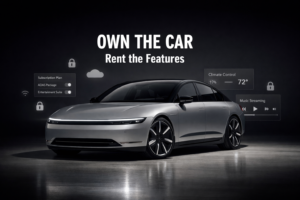
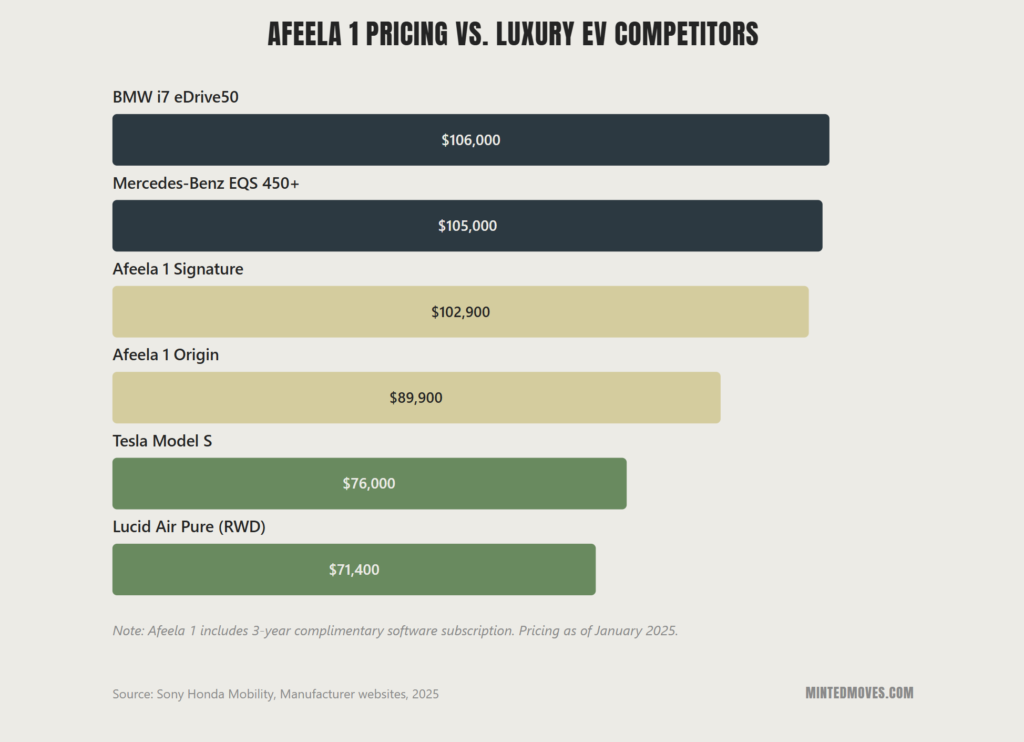
At CES 2023, Sony and Honda unveiled something unexpected: not another PlayStation or Accord, but Afeela—a premium electric sedan that promised to turn cars into “entertainment spaces.”[2] The name drew snickers. The concept raised eyebrows. But by early 2025, reservations opened in California with a base price of $89,900, and the first deliveries are slated for late 2026.[3]
Most automakers launching EVs tout range, acceleration, or sustainability. Afeela’s pitch? PlayStation Remote Play in your backseat, an AI “Personal Agent” that talks to you, and 40 sensors feeding a computing brain capable of 800 trillion operations per second (TOPS).[2] It’s less “car company makes EV” and more “what if Sony built a Tesla?”
Here’s why two giants from entirely different industries decided now was the moment to merge their DNA—and what that says about where the auto industry is headed.
The Strategic Logic: What Each Side Gets
Honda’s Perspective: Catching Up Without Going Alone
By the early 2020s, Honda found itself behind in the EV race. While Tesla dominated and European brands rolled out electric lineups, Japanese automakers lagged.[5] Honda’s first major EV, the Prologue SUV, wouldn’t arrive until 2024—and it used GM’s platform, not Honda’s own technology.[5]
This is where Sony comes into the picture. Sony brought deep pockets, cutting-edge sensors, and a content empire spanning gaming, music, and film. For Honda, the joint venture became a way to accelerate EV development without shouldering all the risk. As one industry analyst put it, from Honda’s perspective, Sony is essentially helping “pay for Honda’s own EV development and to catch up” in the electric race.[5]
The math works for Honda in three ways. First, the Afeela platform uses Honda’s upcoming e:Architecture EV system, meaning lessons learned here flow back into Honda’s own future models.[5] Second, production happens at Honda’s Ohio facilities, keeping factories running and workers employed while monetizing existing capacity.[3] Third, if Afeela flops, Honda’s core brands remain insulated—there’s no “Honda Afeela” badge to tarnish.
Sony’s Perspective: Building a New Revenue Stream
Sony doesn’t need to become Toyota. What it wants is a platform to sell software, services, and content—essentially treating cars like smartphones with wheels.
Since 2020, Sony had been testing the Vision-S concept sedan, showcasing its imaging sensors and infotainment vision.[4] But building cars at scale? That requires factories, supply chains, crash testing, and regulatory approval—areas where Sony had zero experience. Partnering with Honda solved that overnight.
Sony’s executives have been blunt about the goal: this isn’t about selling millions of cars. It’s about creating a new revenue stream through subscriptions, digital services, and ecosystem lock-in.[5] The car comes with a free three-year subscription to advanced driver assistance, cloud connectivity, and entertainment features.[3] After that? Users pay to keep those features active—much like renewing Apple iCloud or PlayStation Plus.
More significantly, Sony gains control over the user experience. The infotainment runs on Unreal Engine (Epic Games’ graphics platform), features Sony’s 360 Reality Audio, and integrates PlayStation Remote Play natively.[2] No other automaker can offer that. If autonomous driving becomes common by the late 2020s, Sony envisions passengers streaming movies, playing games, or working in what it calls “Mobility as a Creative Entertainment Space.”[3]
Why a Joint Venture Instead of a Partnership?
Sony and Honda could have done a looser supplier relationship—Sony provides tech, Honda builds cars, everyone goes home. Instead, they created Sony Honda Mobility Inc., a 50-50 joint venture with equal ownership, shared governance, and co-branded risk.[1]
This structure matters. Both companies put up capital (¥10 billion initial investment), assigned top executives (Honda’s CEO chairs, Sony’s president is COO), and committed to a unified product vision.[1] Neither is just a vendor to the other—they co-own the intellectual property, the brand, and the profits (or losses).
That alignment eliminates the “two bosses” problem common in partnerships. Decisions about trade-offs—say, prioritizing entertainment features over driving range—get resolved within one leadership team rather than through contract negotiations. It also gives both sides skin in the game: if Afeela succeeds, they share the upside equally. If it fails, they share the write-down.
For Sony, the JV structure provides access to Honda’s manufacturing without building factories from scratch—critical since U.S. EV incentives reward domestic production.[5] For Honda, it means Sony can’t easily take the technology and license it to competitors without mutual agreement.
Why Now? Timing and Market Windows
The mid-2020s represent a strategic inflection point in the EV industry—and Sony and Honda likely sensed this was their last clear opening.
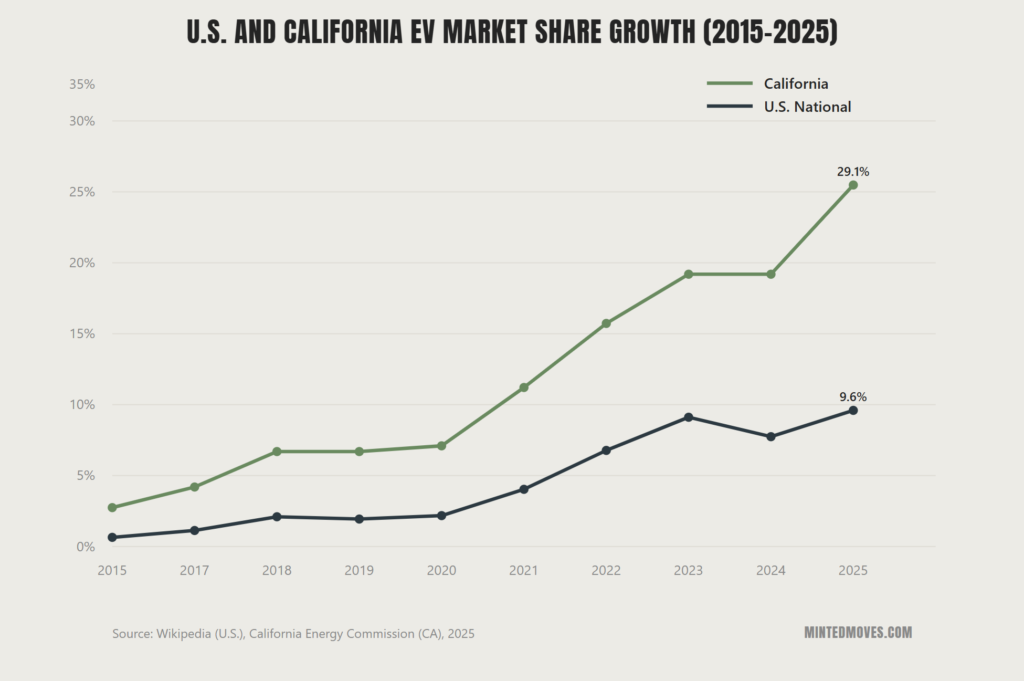
By 2025, EVs had moved from niche to mainstream in key markets. California’s EV share exceeded 15%, and the state mandated a ban on new gasoline car sales by 2035. Consumer acceptance had crossed a threshold. Yet the market hadn’t yet consolidated around a few dominant brands. Tesla led but faced growing competition from legacy automakers and startups. That created a window: late enough that consumers would consider EVs seriously, early enough that a newcomer could still differentiate.
At the same time, the concept of “software-defined vehicles” became industry gospel. Cars increasingly derive value from updatable software, cloud connectivity, and digital services—not just mechanical engineering. Sony saw this shift and thought: if ever there were a time to leverage our software prowess in automobiles, it’s now.
Competitive dynamics also favored action. Tesla’s 2023-2024 price cuts triggered an EV price war, squeezing margins industry-wide. Then, in early 2026, Tesla announced it would discontinue the Model S sedan and Model X SUV by mid-2026 to focus on mass-market models and autonomy.[6] That decision left a gap in the premium EV sedan segment—precisely where Afeela aims to compete. Former Model S buyers looking for a tech-forward, high-end sedan would soon have one fewer option.
Meanwhile, Apple’s Project Titan car—which had been in development for nearly a decade—remained unreleased and largely speculative.[5] Sony and Honda could claim to deliver what Apple couldn’t: an actual product on the road. Among major consumer technology companies attempting to enter the automotive space, that distinction carries weight.
The Product: What Makes Afeela Different?
Afeela 1 is a dual-motor, all-wheel-drive sedan targeting around 300 miles of EPA range.[3] It packs 40 sensors (cameras, radar, ultrasonic, LiDAR), a Qualcomm Snapdragon Digital Chassis delivering 800 trillion operations per second of computing power, and aims for Level 3 conditional autonomy pending regulatory approval.[2][3]
To understand what Level 3 means: autonomous driving is classified into levels 0 through 5. Level 0 has no automation, Level 1 has features like cruise control, Level 2 requires constant driver supervision (like Tesla’s Autopilot), Level 3 allows the car to drive itself in specific conditions while the driver can take their eyes off the road but must be ready to intervene, and Levels 4-5 require minimal to no human intervention.[2] Currently, only Honda (in a Japan-only sedan) and Mercedes (in limited German roads) have deployed Level 3 systems—making it a potential differentiator if Afeela achieves regulatory approval in the U.S.[4]
On paper, that’s competitive but not revolutionary. Many luxury EVs now have LiDAR, multiple screens, and over-the-air updates. What sets Afeela apart—at least in its marketing—is the integration of Sony’s ecosystem.
The cabin features a panoramic dashboard display built with Unreal Engine for high-fidelity graphics, AR navigation overlays, and a voice-activated “Personal Agent” AI.[3] Rear passengers in the Signature trim get dedicated screens. Most distinctively, Afeela supports PlayStation Remote Play, letting passengers stream games from their home PS5 via 5G.[7] No other car offers that natively.
Sony is also experimenting with an open platform for third-party developers, potentially creating an app store for cars.[4] Imagine downloadable themes, unique soundscapes from artists, or user-generated content—essentially treating the car like a smartphone ecosystem. If successful, that could create network effects: the more apps available, the more valuable the platform, the more owners stay loyal.
But here’s the risk: many of these features could be seen as “nice to have” rather than essential. If competitors integrate Xbox Cloud Gaming or if Mercedes partners with Sony Pictures for streaming, Afeela’s uniqueness shrinks. The differentiator isn’t just having features—it’s whether the experience feels cohesive and genuinely enhances daily use.
The Business Model: Hardware as the Hook, Software as the Profit
Sony and Honda aren’t trying to sell cars like Toyota sells Camrys. They’re trying to sell cars like Apple sells iPhones—where the device is the entry point to an ecosystem that generates recurring revenue.
Each Afeela 1 comes with a three-year complimentary subscription to advanced driver assistance (ADAS—Advanced Driver Assistance Systems), connectivity, and entertainment services.[3] After that period ends (around 2029 for early buyers), owners must pay to keep those features active. Pricing hasn’t been announced, but think along the lines of $20-50/month for a bundled “Afeela Entertainment Pass” covering data, gaming, and media.
This subscription approach isn’t without precedent—or risk. BMW famously attempted to introduce a subscription fee for heated seats and heated steering wheels in 2022, sparking immediate consumer backlash.[8] The company quickly reversed course after customers rejected the idea of paying monthly for hardware already installed in their vehicles. The key difference: BMW tried to charge for physical features, while Afeela is charging for software services and cloud connectivity. Whether consumers see that distinction as meaningful remains to be tested.
If Sony Honda Mobility can convince owners that those services are indispensable—that turning them off feels like downgrading their car—they unlock a revenue stream that traditional automakers rarely tap. Tesla pioneered this with Full Self-Driving subscriptions; Afeela is betting it can go further by integrating content Sony already owns.
Beyond subscriptions, Sony could monetize through an app marketplace (taking a cut of third-party app sales), insurance products (using driver monitoring data), or even licensing the platform to other automakers down the line. The long game isn’t necessarily to sell millions of Afeelas—it’s to prove that cars can be software platforms and then scale that model.
The challenge? Building that ecosystem requires massive upfront investment in software development, cloud infrastructure, and content licensing—all while selling a relatively low volume of expensive cars. Sony Honda Mobility executives have said they expect the venture to turn a profit by the end of the decade, which implies years of subsidized operations.[4]
What Could Make This Fail?
Launching a new EV brand in 2026 is extraordinarily difficult. The risks stack up quickly.
Scale and cost economics top the list. Low production volume means high per-unit costs. If Afeela sells only a few thousand cars annually, achieving economies of scale becomes nearly impossible. Without scale, they either lose money per vehicle or raise prices further—shrinking the addressable market even more. For context, other luxury EV startups have struggled with similar challenges. Rivian, which launched its R1T pickup and R1S SUV in 2021, reported losses of over $1.4 billion in Q4 2023 alone despite higher production volumes.[9] Lucid Motors, targeting a similar premium segment with its Air sedan, has burned through billions while producing fewer than 10,000 vehicles annually.[10] Both companies have had to raise additional capital multiple times to stay afloat. Afeela benefits from corporate parents with deep pockets, but the economics of low-volume luxury EV production remain brutal regardless of backing.
Software execution is another major hurdle. Delivering a bug-free, intuitive user experience is hard. Early adopters will be merciless if the voice assistant misunderstands commands or if over-the-air updates break features. More critically, any failure in the Level 2+ driver assistance system could invite lawsuits and regulatory scrutiny, undermining trust before the brand gets off the ground.
Brand skepticism looms large. Afeela is asking consumers to pay Mercedes-level prices for an unfamiliar badge. The name itself drew mockery when first announced.[5] Building brand equity from scratch requires flawless execution, strong word-of-mouth, and probably some luck. One high-profile recall or quality issue could derail momentum.
Competition won’t stand still. If rivals quickly adopt similar features—say, Mercedes integrating gaming via partnerships or Hyundai offering comparable driver assistance systems at $70,000—Afeela’s premium pricing becomes harder to justify. The tech industry moves fast; automotive differentiation can evaporate in a product cycle.
Finally, macroeconomic and policy risks matter. If interest rates stay elevated or a recession curtails luxury spending, demand for $90,000 sedans will suffer. Changes in EV incentives or direct-sales laws could also complicate rollout plans.
What to Watch in the Next 24 Months
Several milestones will signal whether Afeela is on track or encountering headwinds.
First, final specs and EPA ratings should emerge by late 2025 or early 2026. Does the car hit its 300-mile range target? If it falls short—or if competitors leapfrog with 400-mile ranges—that’s a red flag.
Second, regulatory approval for Level 3 autonomy in at least one market (likely Japan or California) would be a major win. If by mid-2026 they can offer hands-off, eyes-off highway driving in traffic jams, that’s a genuine differentiator in the U.S. market.
Third, customer reception will be telling. Early reviews from automotive journalists and initial owner feedback (by late 2026) will reveal whether the software experience lives up to the hype. If reviewers say “best infotainment in any car,” that builds momentum. If they say “gimmicky,” that’s trouble.
Fourth, reservation and delivery numbers—even if not publicly disclosed—will leak through various channels. If waitlists stretch into 2027, demand is strong. If cars sit available immediately, interest is tepid.
Fifth, expansion plans beyond California signal confidence. Watch for announcements about Arizona (slated for 2027), additional U.S. markets, or even Europe.[4] Rapid expansion suggests internal sales targets are being met.
Finally, the SUV prototype shown at CES 2026 should progress toward production.[7] If Sony Honda Mobility confirms a 2028 launch timeline for that second model, it implies Afeela 1 performed well enough to justify continued investment.
The Bigger Picture: Testing the Limits of the Software-Platform Car
Afeela isn’t just Sony and Honda’s experiment—it’s testing the limits of whether cars can truly become software platforms.
For decades, automakers made money selling vehicles, financing loans, and servicing them. Software was an afterthought. Infotainment systems lagged consumer electronics by years. Over-the-air updates were rare. That model is being challenged by Tesla, Chinese EV makers like NIO and Xpeng, and now Afeela.
If Sony Honda Mobility succeeds in convincing buyers to pay recurring fees for digital services, it validates a new business model. Other automakers will rush to replicate it. If it fails—if owners refuse to subscribe or if the ecosystem doesn’t materialize—it suggests consumers still view cars as hardware purchases, not service platforms.
The stakes extend beyond one joint venture. Sony’s approach of treating mobility as an extension of its entertainment empire could reshape how tech companies view transportation. Honda’s willingness to share its manufacturing with a partner challenges the traditional vertically integrated automaker model.
Whether Afeela becomes a niche success, a cautionary tale, or something in between, it’s a clear signal: the boundaries between consumer electronics, software, and automotive are dissolving. The companies that figure out how to navigate that convergence will define the next era of mobility.
For now, the Afeela 1 is a $90,000 bet that the future of cars looks a lot less like driving—and a lot more like living.
References
[1] Sony Honda Mobility Inc. – “Sony and Honda Sign Joint Venture Agreement to Establish New Company ‘Sony Honda Mobility Inc.'” – June 16, 2022 – Available at: https://global.honda/en/investors/library/filings/filings20220616103046/main/0/link/CY2022_20220616_TSEfiling_e.pdf
[2] Sony Honda Mobility – “Sony Honda Mobility New Brand AFEELA Announced Prototype Unveiled at CES 2023” – January 4, 2023 – Available at: https://www.shm-afeela.com/en/news/2023-01-04/
[3] Sony Honda Mobility – “Sony Honda Mobility Introduces AFEELA 1 at CES 2025” – January 6, 2025 – Available at: https://www.shm-afeela.com/en/news/2025-01-06_5/
[4] WardsAuto – “Sony Honda Mobility of America’s CEO remains confident in EV market” – January 16, 2026 – Available at: https://www.wardsauto.com/news/sony-honda-mobility-of-americas-ceo-remains-confident-in-ev-market/809396/
[5] The Verge – “Sony and Honda’s EV goes where the Apple Car never did” – January 23, 2023 – Available at: https://www.theverge.com/2023/1/23/23564431/sony-honda-ev-afeela-apple-subscription-lease-software
[6] Electrek – “Elon Musk kills Tesla Model S and Model X because of ‘autonomy'” – January 28, 2026 – Available at: https://electrek.co/2026/01/28/elon-musk-kills-tesla-model-s-x-autonomy/
[7] Car and Driver – “Afeela Reveals SUV Prototype at CES as Sedan Nears Production” – January 6, 2026 – Available at: https://www.caranddriver.com/news/a69924992/afeela-suv-prototype-2026-revealed/
[8] The Drive – “BMW Stops Charging Subscription Fees for Heated Seats” – September 15, 2022 – Available at: https://www.thedrive.com/news/bmw-stops-charging-subscription-fees-for-heated-seats
[9] CNBC – “Rivian posts Q4 loss of $1.5 billion as EV maker ramps production” – February 21, 2024 – Available at: https://www.cnbc.com/2024/02/21/rivian-rivn-earnings-q4-2023.html
[10] Reuters – “Lucid raises $3 billion from Saudi Arabia’s PIF” – August 8, 2023 – Available at: https://www.reuters.com/business/autos-transportation/lucid-raises-3-bln-saudi-arabias-pif-2023-08-08/