We analyzed the economics of the Olympics, and the results are wild. In Russia, Sochi’s Olympic stadium sits empty most of the year. In Greece, Athens’ aquatics center is filled with mud and rodent feces. And in Brazil, Rio’s Olympic Park shuttered entirely within months of the closing ceremony.
Yet when Paris opened reservations to host the 2024 Games, France poured €6.6 billion into seventeen days of sport. When Los Angeles won 2028, the city guaranteed the first $270 million in cost overruns—taxpayer money backstopping a party that research shows almost never turns a profit.
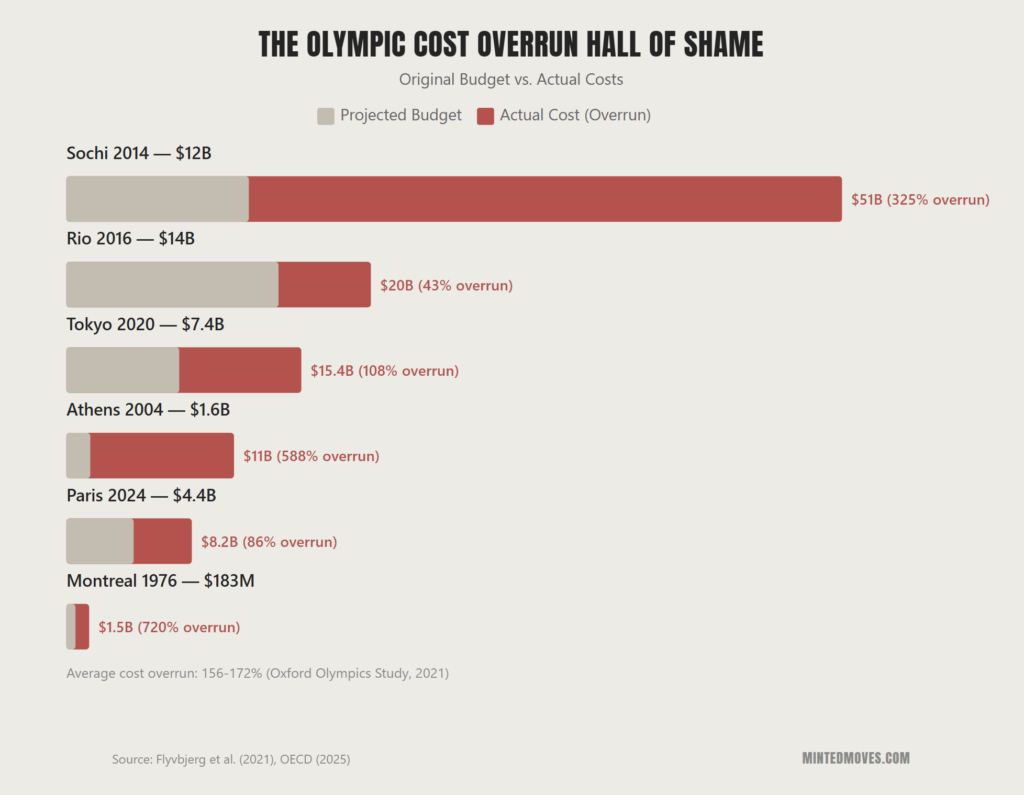
Here’s the pattern cities keep ignoring: more than four out of five Olympic Games run a deficit, with an average return on investment of negative 38% [1]. Every Summer and Winter Olympics since 1960 has blown past its original budget—a 100% cost-overrun rate unmatched by roads (20% average overrun), bridges (34%), or even nuclear plants [1]. Montreal’s 1976 Games produced a 720% cost overrun and a $1.5 billion debt that took the city nearly 30 years to repay.
The answer lies in who actually profits. The International Olympic Committee (IOC) sits atop $4.88 billion in reserves and has $18.4 billion in future revenue already locked in through 2036 [2]. Host cities, meanwhile, bear nearly all the risk while the IOC collects most of the commercial upside.
How the 1984 Los Angeles Olympics Accidentally Created a $12 Billion Industry
Baron Pierre de Coubertin revived the ancient Olympic Games in 1896 with 241 athletes competing in Athens. For the next eight decades, the Olympics operated on an amateur ideal. There were no professional athletes, minimal commercialism, and an International Olympic Committee that functioned as a gentlemen’s club. When Avery Brundage retired as IOC President in 1972, the organization held just $2 million in assets.
By 1980, however, that model was collapsing. Montreal still owed $1.5 billion from hosting four years earlier. This was a debt so crushing the city wouldn’t finish paying it off until 2006. Meanwhile, the Moscow Games had been gutted by a US-led boycott. When the IOC went looking for a 1984 host, only two cities bid: Los Angeles and Tehran. Iran’s revolution eliminated one. Consequently, LA won by default.
Then came the twist: Los Angeles voters had passed a 1978 referendum barring public money from covering Olympic cost overruns. As a result, the first entirely privately financed modern Games would either prove the model could work or collapse spectacularly on live television.
Peter Ueberroth, a travel entrepreneur with no Olympic experience, got handed the job. What he did next became the template every subsequent Games has tried to replicate.
Instead of begging sponsors to chip in $50,000 here and there, Ueberroth sold category-exclusive rights. In other words, one company per industry, $4 million minimum. Coca-Cola got soft drinks. No Pepsi allowed. The artificial scarcity drove prices up tenfold. Additionally, he staged competitive bidding among TV networks. ABC paid $225 million for broadcast rights, nearly ten times what Montreal had extracted. He used existing venues almost exclusively, spending just $546 million total.
The result? The Games generated over $700 million in total revenue and ended with a $232.5 million profit, the most financially successful Olympics in history [3]. The IOC realized it had been leaving billions on the table.
Juan Antonio Samaranch, who became IOC president in 1980, moved fast. In 1985, the IOC launched The Olympic Partner (TOP) program, which took Ueberroth’s category-exclusive model global. More dramatically, he dismantled Coubertin’s century-old amateur rule that had barred professional athletes from competing. Starting with tennis in 1988 and basketball’s “Dream Team” in 1992, the world’s best athletes could now compete regardless of professional status. This change transformed the Olympics from an amateur tournament into a global showcase for elite sport.
Global broadcast rights grew from $1.2 million for Rome 1960 to $3.1 billion for Tokyo 2020, a 2,500-fold increase [3]. NBC alone committed $7.75 billion through 2032, then added another $3 billion extension through 2036 [2].
The IOC Built a Money Machine. Host Cities Pay to Turn the Crank.
The IOC collected approximately $12 billion in revenue during the 2021–2024 four-year Olympic cycle [2]. Broadcasting accounts for about 61% of that, dominated by NBC’s commitment. Additionally, TOP sponsorships (The Olympic Partner program with global deals from companies like Coca-Cola, Visa, and Toyota) add roughly 18%. Importantly, the IOC controls all global broadcast and sponsorship rights. In contrast, host cities only manage domestic commercial programs, ticketing, and local licensing.
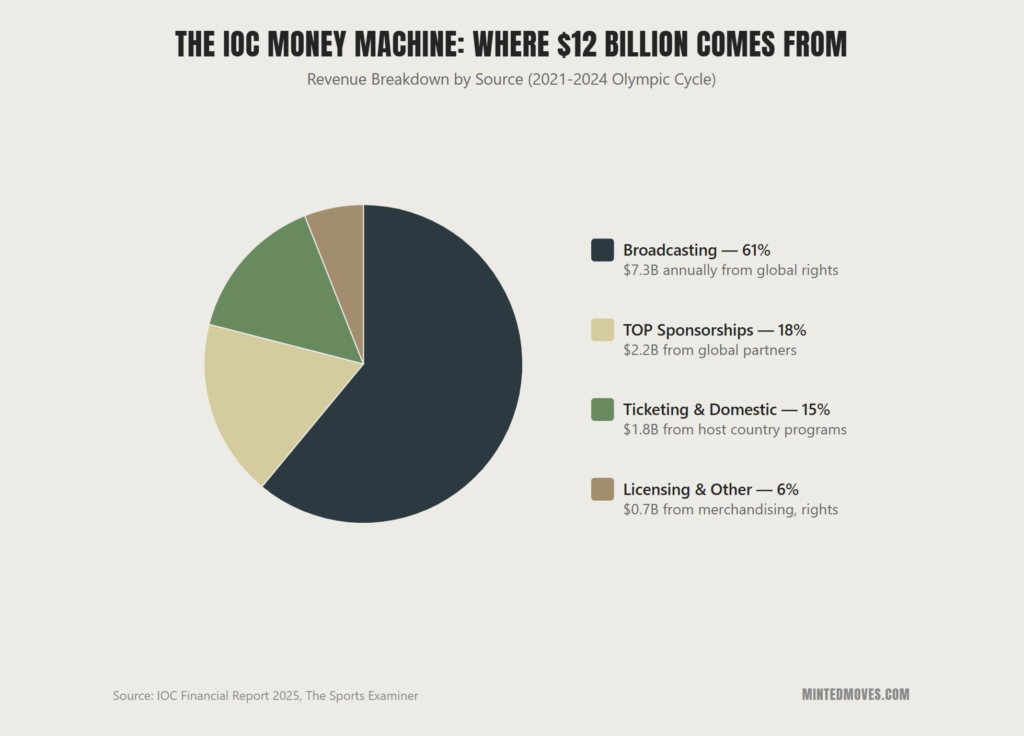
Now here’s the catch: the IOC officially claims to distribute “90% of its revenue” back to the Olympic Movement, which includes National Olympic Committees in each country, International Sports Federations, and organizing committees. However, independent analysis found the actual figure closer to 74–80% [2]. For example, for Paris 2024, the IOC contributed $1.99 billion to the organizing committee. While significant, this was a fraction of France’s total public expenditure of €6.6 billion on the Games [4].
Host cities bear infrastructure costs (stadiums, venues, athlete housing), security expenditures (€1.44 billion for Paris alone [4]), and transportation upgrades. Meanwhile, the IOC collects most of the commercial upside.
Think of it this way: the IOC functions as a franchisor. Cities bid for the privilege of hosting the brand, absorb the capital costs and operational risks, and keep a share of local revenue. The franchisor walks away with global broadcast billions regardless of whether the local “franchisee” makes or loses money.
Except Olympic failures create fiscal crises that can destabilize entire city budgets for decades. Montreal’s debt. Athens’ abandoned venues. Sochi’s billion-dollar annual maintenance burden. The IOC’s reserves, meanwhile, have grown year after year.
The Few Cities That Won—And Why Most Lose
Bent Flyvbjerg’s Oxford Olympics Study found an average cost overrun of 156–172% [1]. Not some Games. Not most Games. Every single one.
Yet a handful of cities pulled off something close to success. Barcelona 1992 cost 266% more than budgeted. Yet the city is almost universally regarded as an Olympic success. Why? Barcelona was an industrial port city with a deteriorating waterfront cut off from residents by factories and warehouses. Consequently, the city treated the Olympics as a catalyst for urban renewal it already needed, not a justification for projects that made no sense otherwise.
Tourism grew from 1.7 million visitors in 1990 to 12 million by 2019 [3]. Additionally, all 15 purpose-built Olympic venues remain in active use today. The city created two miles of beachfront where industrial wasteland had been. While not all of Barcelona’s tourism growth can be attributed solely to the Olympics, the Games accelerated the city’s transformation and put it on the global tourism map in ways that sustained momentum for decades.
London 2012 regenerated 560 acres of industrial East London land. The Athletes’ Village converted into 2,818 homes. However, London’s original £4 billion bid estimate swelled to £9.3 billion, a 133% overrun [5].
The cautionary tales tell a different story. Athens 2004 doubled its budget to approximately $11 billion. Greece’s deficit hit 6.1% of GDP. Moreover, more than half the Olympic venues were abandoned within six years. Consequently, the country lost 70,000 jobs in the three months immediately following the Games [6].
Sochi 2014 ballooned from $12 billion to $51 billion, more than all previous Winter Olympics combined [7]. Russian opposition leader Boris Nemtsov alleged $25–30 billion was stolen through corruption [7]. Furthermore, Russian taxpayers still shoulder roughly $1 billion per year in maintenance costs.
Rio 2016 required a $900 million federal bailout just to cover Olympic-related policing. Meanwhile, an estimated 60,000–77,000 people were forcibly displaced during construction [8]. Subsequently, the aquatics center filled with mud, trash, and rodent feces.
The pattern is clear: cities that use the Olympics to accelerate sensible infrastructure investment can capture lasting value. In contrast, cities that build for the Olympics—creating facilities that only make sense if you’re hosting a global mega-event—end up with expensive monuments to ambition.
The Costs That Don’t Show Up in Official Budgets
The Centre on Housing Rights and Evictions estimated over 2 million people were forcibly relocated to make way for Olympic development across two decades [8]. For instance, Beijing 2008 set the record: 1.25–1.5 million people forcibly relocated [8]. Similarly, Rio removed 60,000–77,000 people, predominantly from favelas.
Each modern Olympics relies on 45,000 to 80,000 unpaid volunteers [9]. Tokyo’s volunteer corps has been valued at approximately $500 million in equivalent labor costs. Nevertheless, NBC paid $7.75 billion for broadcast rights to events built, in part, on unpaid labor for an organization holding billions in reserves.
Construction safety records vary dramatically. For example, Sochi employed roughly 70,000 workers; at least 25 died in 2012 alone [7]. The contrast: London 2012 achieved zero construction fatalities across the entire Olympic build program [5]. London proved that worker safety at Olympic scale is achievable when prioritized.
Paris and LA: Testing Whether “Sustainable Olympics Economics” Is Real
By the mid-2010s, bidding for the 2024 and 2028 Summer Olympics was in crisis. Boston withdrew its 2024 bid after public opposition. Hamburg, Rome, Budapest, and Oslo all abandoned their bids. Consequently, when only Paris and Los Angeles remained, the IOC did something unprecedented. It awarded both the 2024 and 2028 Games simultaneously just to keep the pipeline alive.
Paris 2024 deployed 95% existing or temporary venues, the highest proportion in Olympic history [4]. Only two new permanent facilities were built. The organizing committee budget was 96% privately funded and ended with a €76 million surplus [4].
However, the French Court of Auditors calculated total public costs at €6.6 billion when you count security, infrastructure upgrades, and other government expenditures [4]. Meanwhile, the short-term GDP impact was 0.07 percentage points [10].
Los Angeles 2028 is building no new permanent venues [11]. Instead, competitions will happen at 40+ existing facilities. Furthermore, new revenue streams include Olympic venue naming rights. Partnerships with Honda, Starbucks, and Google are reportedly valued at approximately $200 million each [11].
But the ballot protections from 1984 are gone. LA taxpayers now guarantee the first $270 million in cost overruns, with California taxpayers on the hook for the next $270 million [11]. In essence, Paris and LA are testing whether you can host the Olympics cheaply enough that modest benefits outweigh modest costs. This represents a much lower bar than the “economic windfall” rhetoric suggests.
Why Cities Keep Bidding: The Economics of Olympic Delusion
Wladimir Andreff, an emeritus professor of economics at the University of Paris 1 Panthéon-Sorbonne and leading scholar on sports economics, applies auction theory to Olympic bidding. Cities systematically overestimate benefits and underestimate costs. Consequently, the winning bidder—by definition—is the one most afflicted by optimism bias. In other words, you won because you believed things nobody else did, and you’re probably wrong.
The pattern is relentless. Montreal projected $184 million in costs and spent $1.5 billion. Athens projected $1.6 billion and spent $11 billion. Sochi projected $12 billion and spent $51 billion. The overruns aren’t random. Rather, they’re structural features of how Olympic bidding works.
Why doesn’t this stop cities from bidding? Because the people making the decision (politicians seeking legacy) aren’t the people bearing the costs (taxpayers footing the bill years later). For instance, Boston’s 2024 bid collapsed when voters realized they’d be on the hook. Hamburg’s referendum failed 52–48.
The math is brutal. Total revenue for any single Games rarely exceeds $5 billion. Therefore, when Beijing spends $44 billion, Sochi $51 billion, or Rio $20 billion, there’s simply no plausible revenue scenario that generates a surplus.
What the Olympics Actually Sell
Strip away the spreadsheets: the economics of the Olympics can’t be justified on economics alone.
The measurable costs are concrete. Sochi: $51 billion. Beijing: $44 billion. Rio: $20 billion. The measurable benefits are far smaller. Tourism bumps often don’t materialize. Employment gains are temporary. Moreover, GDP effects are consistently pegged at negligible or negative by academic research [1].
Yet UK residents told researchers they’d willingly pay nearly £2 billion collectively for the intangible benefits of hosting 2012. Civic pride, national identity, the shared experience of a home crowd [5]. Similarly, Barcelona’s transformation from industrial port to global tourist destination was catalyzed by seventeen days in 1992.
Cities that use the Olympics as a catalyst for urban development they already needed can capture lasting value. For example, Barcelona’s waterfront and London’s East London regeneration both served ongoing needs even when the Games themselves lost money. The infrastructure built serves ongoing needs beyond the Olympic fortnight.
In contrast, cities that build for the Olympics end up with expensive monuments to ambition. Athens’s abandoned softball stadium. Sochi’s subtropical ski resort requiring artificial snow year-round. Rio’s Olympic Park that shuttered within months. Consequently, constructing stadiums and facilities that only make sense if you’re hosting a global mega-event becomes a fiscal trap.
The spectacle endures not because it makes financial sense but because nations aren’t rational economic actors. They’re storytellers. And the Olympics remains the world’s most powerful stage for telling a national story to a global audience.
For the IOC, the equation has never been in doubt. Sitting atop $4.88 billion in reserves with $18.4 billion in secured future revenue, the organization has built a money machine that generates billions regardless of whether any particular host city makes or loses money.
For everyone else—the cities bidding, the taxpayers funding, the workers building, the communities displaced—the calculus remains what it’s always been. Gloriously uncertain economics in service of something that defies purely financial measurement.
The Olympics will keep losing money for host cities. And cities will keep lining up to host them anyway.
References
[1] Flyvbjerg, B., Budzier, A., & Lunn, D. — Regression to the tail: Why the Olympics blow up — 2021 — Available at: https://journals.sagepub.com/doi/full/10.1177/0308518X20958724
[2] The Sports Examiner — International Olympic Committee financial report confirms $18.4 billion in confirmed revenues for 2025–36 — January 2025 — Available at: https://www.thesportsexaminer.com/international-olympic-committee-financial-report-confirms-18-4-billion-in-confirmed-revenues-for-2025-36-1-134-billion-2024-surplus/
[3] Council on Foreign Relations — The Economics of Hosting the Olympic Games — 2024 — Available at: https://www.cfr.org/backgrounders/economics-hosting-olympic-games
[4] OECD — Responsible Games: The Legacy of the Paris 2024 Olympic and Paralympic Games — September 2025 — Available at: https://www.oecd.org/en/publications/2025/09/the-legacy-of-the-paris-2024-olympic-and-paralympic-games_fa7c7102/full-report/responsible-games-improving-sustainability-through-infrastructure-and-procurement_073edfc6.html
[5] UK Government — Olympic Games legacy boosts economy by billions — 2013 — Available at: https://www.gov.uk/government/news/olympic-games-legacy-boosts-economy-by-billions
[6] Council on Foreign Relations — The Economics of Hosting the Olympic Games — 2024 — Available at: https://www.cfr.org/backgrounders/economics-hosting-olympic-games
[7] Peterson Institute for International Economics — Corruption Haunts the Winter Olympics in Sochi — February 2014 — Available at: https://www.piie.com/blogs/realtime-economic-issues-watch/corruption-haunts-winter-olympics-sochi
[8] Frontiers in Sports and Active Living — Sport Mega-Events and Displacement of Host Community Residents — January 2022 — Available at: https://pmc.ncbi.nlm.nih.gov/articles/PMC8777052/
[9] IMF Finance & Development — Is It Worth It? — March 2010 — Available at: https://www.imf.org/external/pubs/ft/fandd/2010/03/zimbalist.htm
[10] Tourism Review — Economic Impact of the Paris 2024 Olympics Was Lower Than Expected — November 2024 — Available at: https://www.tourism-review.com/economic-impact-of-paris-olympics-lower-than-expected-news14675
[11] LA28 — LA28 Updates Venue Plan — 2023 — Available at: https://la28.org/en/newsroom/la28-updates-venue-plan.html