
A hot dog and soda for $1.50. The same price it was in 1985.
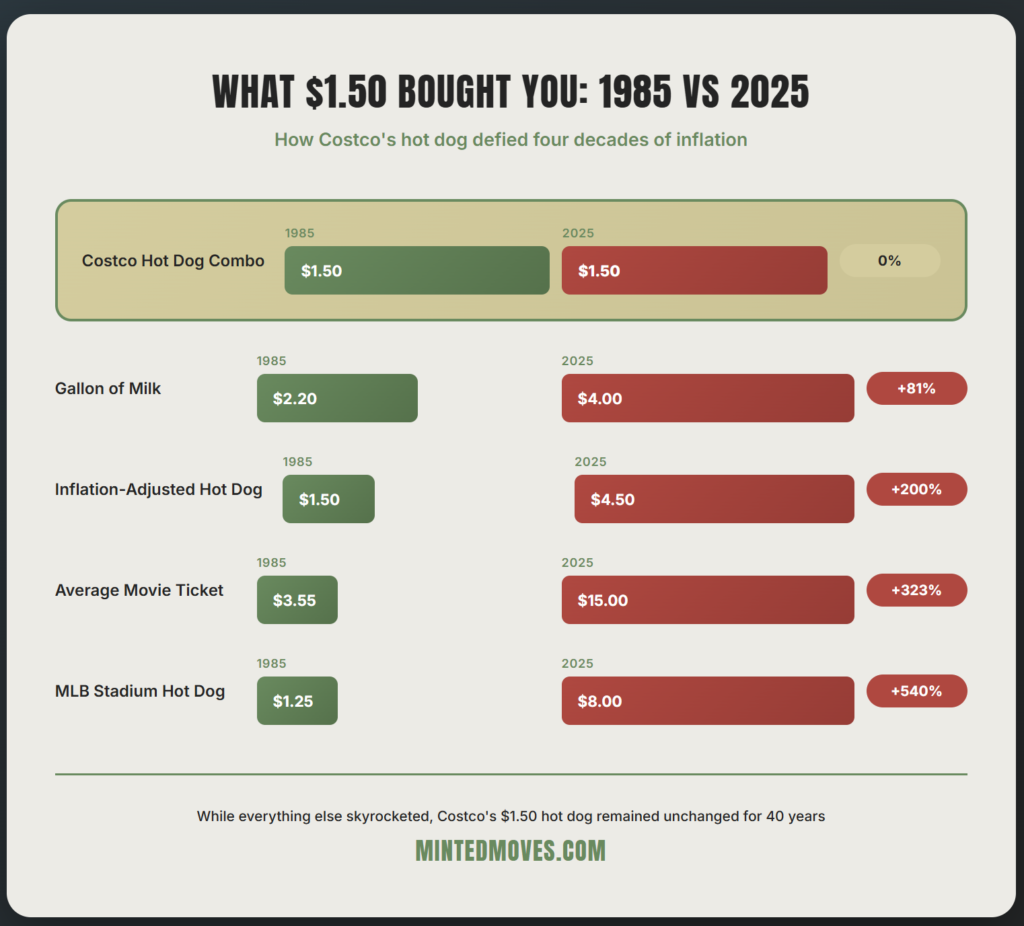
While inflation pushed movie tickets from $3.55 to $18 and stadium hot dogs now cost $9, Costco’s food court combo hasn’t budged. In fiscal year 2025, the company sold 245 million of them[1], potentially forgoing hundreds of millions in revenue to keep that price locked.
This isn’t nostalgia. Instead, it’s strategy.
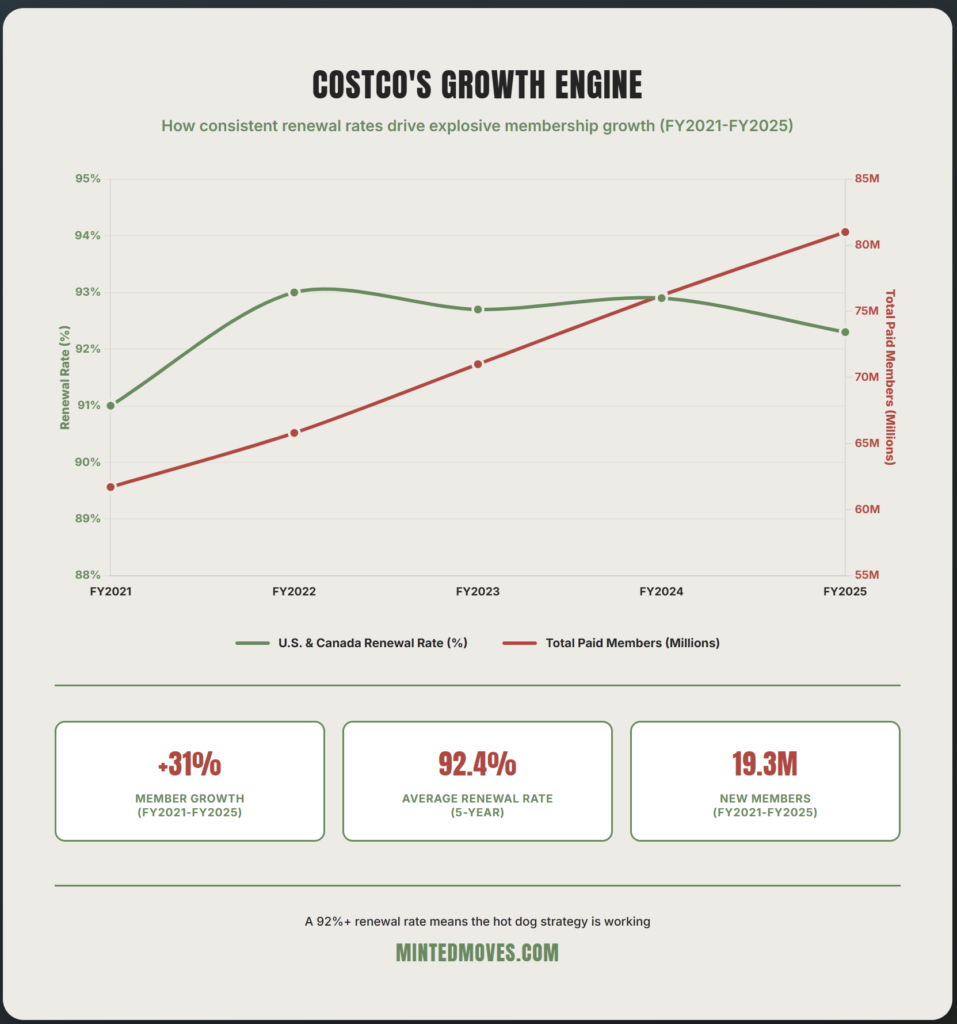
The $1.50 hot dog is Costco’s most visible promise to its 130 million members: we will always choose your wallet over our margin. Moreover, that promise, repeated 245 million times a year, drives one of retail’s highest membership renewal rates at 92.9%[3].
Here’s how Costco’s hot dog strategy helped build the foundation of a $250 billion business.
The Threat That Kept the Price Frozen
In 2013, rising beef costs were squeezing Costco’s food court margins. Consequently, CEO Craig Jelinek approached co-founder Jim Sinegal with a modest proposal: raise the combo price to $1.75.
Sinegal’s response was immediate. “If you raise the effing hot dog, I will kill you. Figure it out.”[4]
The message was clear. Rather than a product line to optimize, the hot dog was a contract.
So Costco figured it out. Initially, the company stopped buying from Hebrew National and built two manufacturing plants in Los Angeles and Chicago[4]. By 2009, Kirkland Signature hot dogs were rolling off Costco’s own production lines, eliminating the supplier’s margin entirely.
The hot dog also got bigger. While most brands were quietly shrinking products, Costco increased its franks by 10% to a full quarter-pound[5]. Furthermore, the switch wasn’t just about cost control; it was about proving that vertical integration could deliver more value, not less.
In 2013, the company switched from Coca-Cola to Pepsi to further reduce beverage costs[4]. Then, in 2025, CEO Ron Vachris announced a return to Coke. The move suggests Costco found enough efficiency elsewhere to afford the higher-margin syrup again while keeping the $1.50 price intact.
Current CFO Gary Millerchip confirmed in early 2025 that the price remains “safe” despite economic uncertainty[2]. Forty years in, the hot dog is no longer just a menu item. Rather, it’s company doctrine.
The Economics: Loss Leader or Break-Even?
Costco doesn’t release specific loss figures for individual food court items[5], so analysts debate whether the hot dog is a true loss leader or simply a zero-margin product.
The case for loss is straightforward. If the hot dog had kept pace with inflation, it would cost between $4.40 and $4.50 today[4]. By holding it at $1.50, therefore, Costco forgoes roughly $3 in potential revenue per unit. Multiply that by 245 million annual sales, and the opportunity cost reaches $735 million[1].
However, opportunity cost isn’t the same as actual loss. Through vertical integration, Costco stripped out supplier margins and gained control over input costs. As a result, some analysts believe the gross margin per hot dog might be slightly positive, perhaps a few cents, once production efficiencies are factored in.
The real loss appears when labor, electricity, and floor space are included. Industry estimates place the net annual impact somewhere between $30 million and $50 million[5], similar to the $30–40 million Costco admits to losing on its $4.99 rotisserie chickens[5].
Yet Costco doesn’t classify these as losses. Instead, the company views them as marketing expenses. Unlike traditional advertising, which Costco famously spends $0 on[5], the hot dog generates billions in earned media and word-of-mouth every year.
The question isn’t whether Costco loses money on hot dogs. Rather, it’s whether the alternative—raising prices and keeping that $735 million—would cost more in lost trust and lower membership renewals.
So far, the answer is clear. Membership fees accounted for 66–73% of Costco’s net profit in recent years[3]. Accordingly, the hot dog’s job isn’t to make money. It’s to make members feel the membership is worth keeping.
The Psychological Architecture
The $1.50 price point works because of what behavioral economists call the “sunk cost effect.”
Once a member pays the $65 annual fee, they feel a psychological need to justify that expense. Consequently, every $1.50 hot dog feels like a $3 rebate on the membership. Every $4.99 rotisserie chicken reinforces the idea that Costco is working for them, not against them.
This creates a feedback loop. Members visit more frequently to “earn back” their fee. Subsequently, more visits lead to higher total spending. The average Costco trip generates a basket size of roughly $150[5], and most of that comes from high-margin bulk goods, not food court items.
The hot dog also serves as a price anchor. If a member can get a quality meal for $1.50, they subconsciously trust that the $1,000 TV or $20 pack of steaks is also priced with integrity[5]. It’s a halo effect that extends across the entire warehouse.
Placement matters too. The food court sits at the exit, not the entrance[5]. Therefore, it’s the reward at the end of the shopping journey, a final positive touchpoint before members leave. That timing reinforces the emotional satisfaction of the Costco experience, making the next visit more likely.
Global Adaptation, Universal Anchor
The Costco hot dog strategy isn’t limited to the United States. Instead, the company maintains roughly equivalent pricing across international markets, adjusting for currency but preserving the psychological anchor.
In Canada, it’s $1.50 CAD. In the UK, £1.50. Moreover, in Mexico, hot dogs come with pickled jalapeños. In Iceland, crispy fried onions. In France, Dijon mustard and mayonnaise[5].
The toppings change, but the price point doesn’t. Costco has determined that the “$1.50” figure itself carries universal psychological weight. It’s low enough to feel like a deal in any currency, and round enough to be memorable.
This global consistency reinforces brand identity. Therefore, a Costco member traveling from Seattle to Tokyo knows exactly what to expect at the food court. That predictability is part of the value proposition.
Even the buns vary by region. Costco sources from local bakeries to save on logistics and ensure freshness[5], which is why members see sesame seed buns in some warehouses and plain, scored buns in others. Nevertheless, the hot dog itself remains uniform: a quarter-pound Kirkland Signature frank, made in Costco’s own plants, priced at the equivalent of $1.50.
It’s a balance between global standardization and local adaptation. Ultimately, the strategy scales because the core economics—turning food into membership loyalty—work the same everywhere.
The Comparison: Costco’s Hot Dog Strategy vs. Rotisserie Chickens Strategy
Costco’s $4.99 rotisserie chicken follows similar logic but with different operational dynamics.
Both items are sold below market rate to drive loyalty. However, the chicken’s placement and function differ. Hot dogs sit at the exit as a reward. Meanwhile, chickens are placed deep in the warehouse, forcing members to walk past thousands of high-margin items to reach them[5].
The chicken also solves a practical problem: dinner. Therefore, it’s a take-home staple that encourages at least one weekly visit. The hot dog, by contrast, is consumed on-site. Consequently, it’s less about utility and more about emotional reinforcement.
Financially, the chicken reportedly costs Costco $30–40 million annually to maintain at $4.99[5]. The hot dog’s estimated $30–50 million loss is comparable[5], though the higher volume (245 million hot dogs vs. roughly 100 million chickens) means the per-unit subsidy is smaller.
Both strategies rest on the same principle: sacrifice short-term margin to build long-term trust. Moreover, both have become so iconic that raising their prices would generate immediate backlash and media scrutiny, which is exactly why Costco won’t do it.
What Costco’s Hot Dog Strategy Reveals About Retail Power
The $1.50 hot dog isn’t just a pricing quirk. Rather, it’s a window into how modern retail power is built.
Traditional retailers optimize per-transaction margins. Costco, however, optimizes lifetime value. The company doesn’t care if it loses a few dollars per hot dog because it makes those dollars back—and then some—through membership renewals and increased shopping frequency[3].
This model only works at scale. Costco sold 245 million hot dogs in 2025 because it has 130 million members and 600+ warehouses[1]. Consequently, a smaller retailer couldn’t absorb the same losses, and a competitor trying to match the price without vertical integration would bleed cash.
That’s the moat. It’s not the hot dog itself. Instead, it’s the entire system: owned manufacturing, membership fees funding operations, and a brand promise so strong that breaking it would cost more than keeping it.
The hot dog is proof that Costco can do what it says. Furthermore, in a retail environment where shrinkflation and hidden fees erode trust daily, that proof is worth far more than the $735 million in foregone revenue.
The numbers tell the story. Costco’s membership renewal rate has held above 90% for years[3], and the company continues to open new warehouses globally. All of it traces back, at least in part, to a decision made in 1985 to sell a hot dog for $1.50 and never raise the price.
The Real Product
Costco doesn’t sell hot dogs. Instead, it sells the feeling that someone is looking out for you.
Every time a member walks past that $1.50 sign, they’re reminded that this company won’t nickel-and-dime them. Moreover, that the membership fee is an investment, not a scam. That Costco’s interests align with theirs.
That feeling is what drives 245 million hot dog sales. Furthermore, it’s what keeps renewal rates near 93%. And it’s what turns a warehouse into a ritual.
The hot dog is the proof. The membership is the product. Consequently, the strategy—forty years in—remains untouched because it works better than any alternative Costco has found.
References
[1] Yahoo Finance (September 2025) – “Costco CFO calls hot dog combo important amid ‘economic uncertainty'” – CFO Gary Millerchip fiscal 2025 earnings call – Available at: https://finance.yahoo.com/news/costco-cfo-calls-hot-dog-153726015.html
[2] CNN Business (May 2024) – “Costco’s $1.50 hot dog price is ‘safe'” – CFO Gary Millerchip earnings call statement – Available at: https://www.cnn.com/2024/05/31/food/costco-hot-dog-price/index.html
[3] WebProNews (December 2024) – “Costco’s Netflix-Like Membership Model Drives 73% of Profits” – Available at: https://www.webpronews.com/costcos-netflix-like-membership-model-drives-73-of-profits/
[4] Wikipedia (2025) – “Costco hot dog” – Historical timeline and corporate details – Available at: https://en.wikipedia.org/wiki/Costco_hot_dog
[5] Queen’s Business Review (October 2024) – “Hotdog Heaven: The $1.50 Secret to Costco’s Success” – Available at: https://www.queensbusinessreview.com/articles/hotdog-heaven-the-150-secret-to-costcos-success