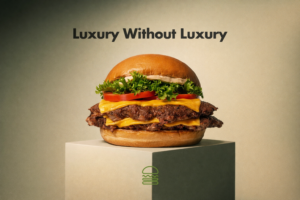
A Double ShackBurger costs about the same as a Big Mac combo. Yet one makes you feel like you’ve treated yourself, while the other just fills you up.
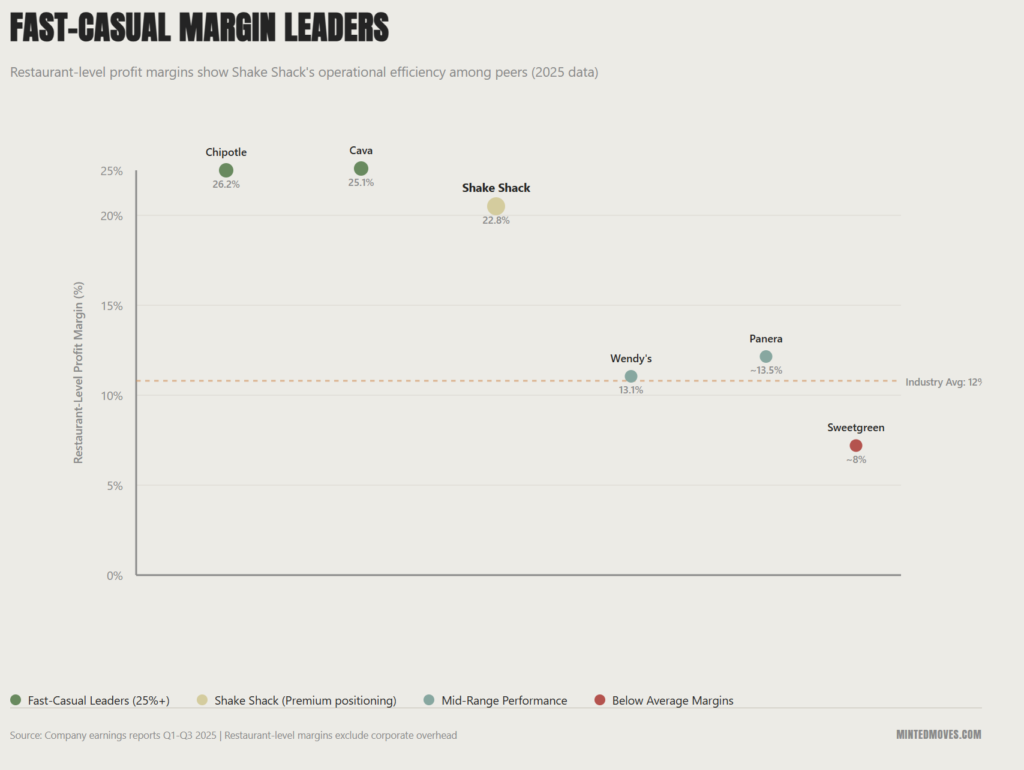
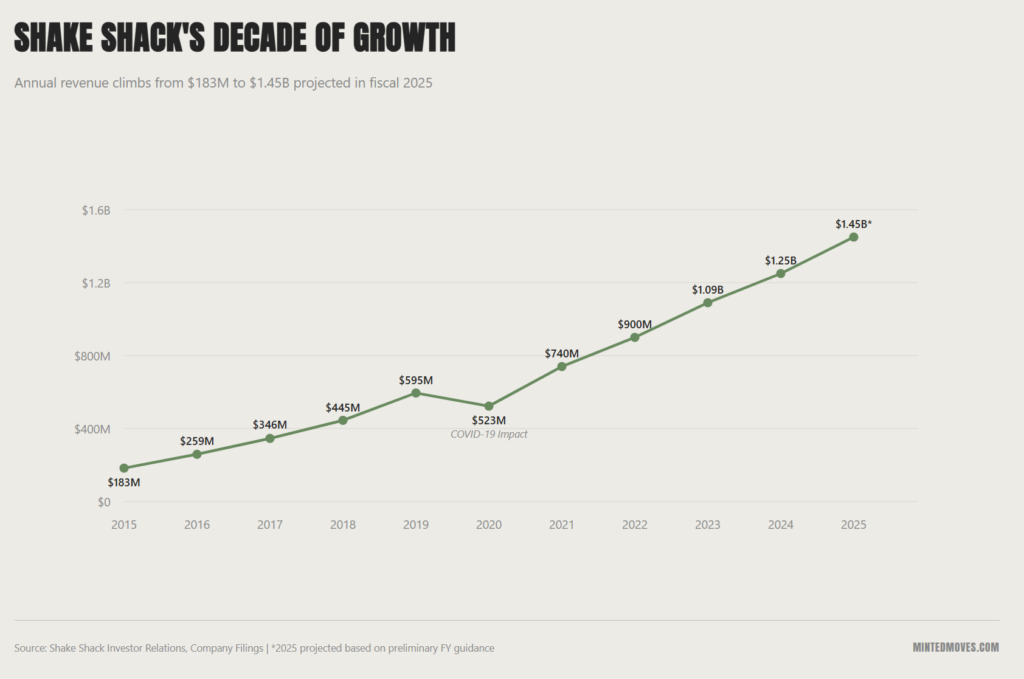
That’s the paradox Shake Shack has mastered. The chain sells premium burgers at prices that feel expensive compared to McDonald’s but reasonable next to a sit-down restaurant. Full-year 2025 revenue is projected at approximately $1.45 billion with restaurant-level profit margins reaching 22.5% to 22.7%—among the highest in fast-casual dining. [1] The company opened 45 new locations in 2025, the largest annual expansion in its history. [1]
The secret isn’t just better beef. Shake Shack cracked a cultural code: how to sell status through quality cues rather than luxury branding, then position that premium experience as an affordable treat when bigger indulgences slip out of reach.
A Brief History of Shake Shack: The Fine Casual Formula
Danny Meyer—the restaurateur behind Michelin-starred establishments like The Modern (two stars) and Gramercy Tavern (one star)—founded Shake Shack in 2004 with a different vision. [2] He calls it “fine casual”: the culinary philosophy of fine dining delivered at fast-food speed.
The distinction matters. Shake Shack uses the same Pat LaFrieda beef blend (sirloin, brisket, short rib) that Meyer’s upscale restaurants serve, just assembled in a park stand instead of plated with wine pairings. [3] The first Shake Shack recipes were even tested in the kitchens of Eleven Madison Park, another Meyer restaurant that held three Michelin stars before he sold it in 2011. [2]
That ingredient story becomes a status signal. You’re not just buying lunch—you’re accessing the same quality wealthy diners pay $50 for, just in burger form.
The brand reinforces this through design restraint. Working with Pentagram—a renowned international design firm—Shake Shack created an iconic visual identity: clean typography, minimalist packaging, retro-modern graphics. [4] No flashy colors or over-the-top messaging. The aesthetic whispers “we’re confident enough to keep it simple” rather than shouting “premium luxury.”
Every Shake Shack globally uses the same core design language, the kind of brand consistency luxury houses obsess over. The company even listed this visual identity as a strategic asset in its IPO prospectus—unusual for a burger chain. [4]
This matters because restraint expands the addressable market. A burger stand in Madison Square Park invites everyone to queue up—executives in suits next to students in hoodies. There’s no dress code, no intimidating atmosphere, no sense you need a certain income to belong. Yet the experience signals good taste, creating a form of status accessible to anyone willing to spend $15.
Shake Shack sells “having discerning taste” as the status symbol, not spending for spending’s sake.
What Shake Shack Actually Sells
Strip away the burgers and shakes, and Shake Shack sells something simpler: permission to feel good about a small indulgence.
The brand’s “Stand For Something Good” ethos reinforces this. Hormone-free beef, sustainable sourcing, community investment—these aren’t just marketing claims. They’re the reason you can tell yourself this $7 Shackburger is worth it. You’re supporting quality, not just spending.
A $15 burger outing costs less than half a tank of gas, less than a movie for two, and a fraction of a dinner reservation. It’s affordable enough to rationalize yet premium enough to feel special.
This permission structure explains Shake Shack’s resilience across economic cycles. The company isn’t selling calories or convenience—plenty of cheaper options exist for that. It’s selling the feeling that you’ve done something good for yourself, that you have discerning taste, that you deserve this moment of quality.
The ingredient story matters because it validates the choice. When you’re spending $15 on lunch, you need a narrative that makes it feel smart rather than wasteful. “Same beef as a Michelin restaurant” provides that narrative. You’re not being extravagant—you’re being savvy about where to find quality.
This psychological framing explains why Shake Shack maintains pricing power even when labeled “expensive.” Despite macroeconomic headwinds in late 2025—including weather challenges and consumer spending pressure—the company maintained its premium positioning and outperformed expectations. [1] Management’s confidence stems from menu strategy, culinary innovation, and the carefully curated limited-time offer (LTO) calendar designed to drive traffic.
When the experience delivers—great taste, warm service, inviting atmosphere—that $15 becomes an investment in your own well-being rather than frivolous spending. The brand’s entire operation aims to stack enough goodwill that customers finish thinking “worth it” instead of “why did I spend that much?”
The Treat Meal Economy
When money tightens, discretionary spending doesn’t vanish—it shifts form.
Economists call this the “lipstick effect”: consumers facing economic stress substitute small luxuries for big ones. [5] A $4 latte replaces the beach vacation. A premium burger replaces the $150 date night. During the Great Depression, cosmetics sales rose while industrial production halved—a pattern that has repeated through subsequent downturns. [6]
Shake Shack sits perfectly in this reallocation. More special than McDonald’s, cheaper than casual dining, it becomes the splurge consumers protect even as they cut elsewhere.
The 2008 recession illustrated this pattern. Casual dining suffered badly while fast-food held steady. [7] Fast-casual restaurants, positioned between value meals and full-service, captured consumers trading down from nicer restaurants but still seeking an experience. During that period, Starbucks maintained relevance by introducing value offerings like $3.95 breakfast combos while preserving its “affordable luxury” positioning. [8]
The COVID-19 era reinforced it. After lockdowns ended, people sought immediate pleasures—a good meal out felt like reclaiming normalcy. Lines outside reopened restaurants weren’t just about food; they represented affordable joy in uncertain times.
Today, over half of Gen Z buys themselves a small treat weekly as a mood booster. [9] They call it “treat culture”—purposeful indulgences that deliver emotional returns disproportionate to cost. A $20 Shake Shack outing isn’t wasteful spending; it’s investing in your own sanity when larger pleasures feel out of reach.
This mental accounting protects the purchase. People create notional budgets for “small joys” separate from essentials, and they preserve that bucket even when overall income drops. A planned Friday burger becomes something to look forward to, a reward that feels deserved rather than frivolous.
The emotional ROI is high. When you’ve skipped new clothes and canceled the vacation, that ShackBurger and shake deliver outsized happiness per dollar.
In the recent K-shaped recovery, higher-income households maintained dining spending while lower-income consumers cut back on fast food frequency. [10] Fast-casual and casual dining outperformed quick-service restaurants because wealthier diners preferred experience over price, and aspirational consumers saved special meals for occasions. [10]
The brand captured both ends: affluent urbanites who’d rather have a great burger than mediocre fast food, plus middle-income families treating themselves monthly instead of weekly. The economic environment strengthens this positioning. During inflation or recessions, Shake Shack becomes the splurge that replaces bigger ones. The $20 you’d spend on a date night at a casual restaurant now buys two people Shake Shack. You still get to eat out, still feel treated, but at half the cost of the alternative.
Premium Without the Premium Problem
Here’s Shake Shack’s challenge: consumers rated it the most overpriced fast-food chain in 2024. [11] Yet the company keeps growing.
The perception gap stems from anchored expectations. Most people mentally compare burger prices to McDonald’s combos, not to $18 casual dining burgers. When a ShackBurger ($7), fries ($3.25), and shake ($5.50) total $16 before tax, it triggers sticker shock—even though the quality justifies the price.
Shake Shack’s unbundled pricing amplifies this. Unlike combo meals with a single visible price, à la carte ordering makes you watch the total climb with each addition. You came for “just a burger” but the menu tempts you into the full experience. Each line on the receipt becomes another number your brain registers.
The company recognized the optics issue. In 2025, Shake Shack rolled out its first-ever combo deal—a chicken sandwich, fries, and soda for $9.99, framed as a “$17.97 value if purchased separately”. [12] That reveal shows how much customers were spending individually.
Yet loyal customers keep coming back, which suggests the “expensive” label is most acute among new visitors or those comparing options. Devotees have adjusted their internal anchors: “It’s $15, but the quality justifies it.”
The key is ensuring the experience delivers emotional value that makes the receipt feel like a souvenir rather than evidence of overspending. If the burger’s great, the service warm, and the atmosphere inviting, that $18 total becomes a story about treating yourself well. If the experience disappoints, those same numbers on the page loom large.
The Receipt as Narrative
Think of a Shake Shack receipt as telling a story, and customers interpret that story based on their experience.
For satisfied customers, the receipt is a souvenir: “We had ShackBurgers, shared fries, tried that new seasonal shake—what a nice time.” The numbers fade into background details of a good memory.
For disappointed customers, the same receipt becomes evidence of being overcharged: “We paid $24 for basically fast food.” The numbers dominate the narrative because the experience didn’t justify them.
Shake Shack’s entire operation aims to tip this interpretation toward the former. The friendly service, modern design, quality ingredients, and brand story about craft all add intangible value. If those elements land, the receipt’s dollar amounts become footnotes to “best burger ever” or “such a fun outing.”
This volatility explains why the brand can be simultaneously loved and criticized for pricing. The dividing line isn’t the actual cost—it’s whether the experience banked enough goodwill to make the price feel fair.
The company’s recent moves acknowledge this tension. App-exclusive deals give budget-conscious consumers an entry point without eroding in-store premium positioning. Discounts hide in the app, preserving the walk-in aura while offering value to those who seek it. [13]
The first combo meal launch in 2025 serves a similar purpose—addressing perception that “it’s expensive” while maintaining quality standards that justify the cost. [12]
The balancing act is delicate. Offer too many deals and you risk becoming just another burger chain. Offer too few and you price out customers who might become loyal fans if given an affordable entry.
So far, Shake Shack threads this needle by channeling value through digital channels while keeping physical locations premium. You can get a deal if you download the app, but walking into a Shack still feels like treating yourself.
Scaling Without Losing the Magic
Shake Shack now operates 373 company-owned locations and over 660 system-wide, with plans to reach at least 1,500 company-operated Shacks long-term. [1] That ambition reflects confidence that the premium model scales profitably.
The brand concentrates in high-foot-traffic urban cores: city centers, premium shopping districts, tourist destinations. These spots carry high rents but enable massive volume. A Midtown Manhattan Shack might serve thousands of customers daily, churning through orders at a pace that justifies the expensive real estate.
In Q3 2025, same-store sales grew 4.9% year-over-year, with total revenue reaching $367.4 million—up nearly 16% from the prior year. [14] Restaurant-level profit margins hit 22.8%, demonstrating the model’s efficiency even as the company expands. [14]
The menu strategy fuels this growth. Shake Shack curates a set menu with seasonal limited-time offers. Those LTOs drive traffic (people visit specifically for a new collaboration shake) and keep the brand culturally relevant. Recent hits like the Dubai Chocolate Pistachio Shake generated lines and social media buzz, proving the strategy’s effectiveness.
Digital advancements support throughput. Nearly 40% of revenue now flows through digital channels, with new digital menu boards in drive-thrus cutting order times. [1] Self-order kiosks and mobile ordering help manage crowds while increasing average check sizes.
The brand’s expansion includes drive-thru formats—something Meyer’s original Madison Square Park kiosk concept never anticipated. Yet the adaptation makes sense for reaching suburban markets where car culture dominates. The company plans to open 55-60 new company-operated locations in 2026, continuing its aggressive growth trajectory. [1]
This flexibility demonstrates Shake Shack’s core insight: the premium positioning isn’t about format, it’s about experience. Whether you’re walking up to a park stand or pulling through a drive-thru, what matters is that the food delivers on the quality promise and the interaction feels warm.
The Bigger Trade-Off
As Shake Shack expands toward 1,500 locations, it faces the classic premium brand dilemma: can you scale without diluting what makes you special?
Moving into suburbs and smaller markets means encountering customers with different expectations. Urban consumers might accept $16 as normal for lunch. Suburban families might balk unless they see clear value signals—hence combo meals and drive-thrus in expansion markets.
The brand must preserve its premium positioning (the reason people choose it over McDonald’s) while adapting to markets where “affordable treat” means something different than it does in Manhattan.
The treat meal economy works in Shake Shack’s favor here. During uncertain economic times, consumers become more intentional with spending but don’t eliminate joy—they rebalance it into affordable experiences. A gourmet burger fits that frame better than most retail purchases.
What Shake Shack ultimately sells isn’t burgers. It’s a $15 version of feeling good about yourself—a way to indulge without guilt, to signal good taste without pretension, to reward yourself when bigger rewards aren’t available.
In a world where people skip vacations but need something to look forward to, that $15 burger becomes the getaway you can actually afford.
And that, more than any ingredient story or design choice, explains why people keep lining up even as they complain about the price. The receipt might make them wince, but the experience makes them feel like they did something good for themselves.
Which is exactly what you’re paying for.
References
[1] Shake Shack Inc. – Shake Shack Provides Fiscal Fourth Quarter 2025 Business Update – January 12, 2026 – Available at: https://investor.shakeshack.com/press-releases/press-release-details/2026/Shake-Shack-Provides-Fiscal-Fourth-Quarter-2025-Business-Update/default.aspx
[2] Michelin Guide – Danny Meyer’s New York: Creating Shake Shack and MICHELIN-Star Restaurants – June 11, 2025 – Available at: https://guide.michelin.com/us/en/article/travel/danny-meyer-michelin-star-shake-shack-new-york-nyc-restaurants
[3] Serious Eats – In-N-Out vs. Five Guys vs. Shake Shack: The First Bi-Coastal Side-By-Side Taste Test – Available at: https://www.seriouseats.com/in-n-out-vs-five-guys-vs-shake-shack
[4] Pentagram – Shake Shack – Available at: https://www.pentagram.com/work/shake-shack
[5] Investopedia – Lipstick Effect: Definition, Theory, and Value As Economic Indicator – Available at: https://www.investopedia.com/terms/l/lipstick-effect.asp
[6] Wikipedia – Lipstick effect – October 28, 2025 – Available at: https://en.wikipedia.org/wiki/Lipstick_effect
[7] USDA Economic Research Service – Recession Had Greater Impact on Visits to Sit-Down Restaurants – March 2015 – Available at: http://www.ers.usda.gov/amber-waves/2015/march/recession-had-greater-impact-on-visits-to-sit-down-restaurants-than-fast-food-places
[8] Nation’s Restaurant News – Upscale brands positioned as less luxury, more valuable – Available at: https://www.nrn.com/restaurant-segments/upscale-brands-positioned-as-less-luxury-more-valuable
[9] Fortune – Gen Z spends hundreds a month on ‘treat culture,’ justifying it with the challenges of daily life – August 19, 2025 – Available at: https://fortune.com/2025/08/19/gen-z-treat-culture-spending/
[10] Business Insider – America’s K-Shaped Economy Is Breaking Fast Food’s Old Playbook – February 2026 – Available at: https://www.businessinsider.com/america-k-shaped-economy-breaking-fast-food-playbook-2026-2
[11] RetailWire – Shake Shack, Five Guys Named Most Overpriced Fast-Food in America – Available at: https://retailwire.com/discussion/shake-shack-five-guys-overpriced/
[12] Nation’s Restaurant News – Shake Shack launches its first combo meal, featuring its chicken sandwich – Available at: https://www.nrn.com/fast-casual/shake-shack-launches-its-first-combo-meal-featuring-its-chicken-sandwich
[13] Nation’s Restaurant News – Shake Shack also has a value proposition – Available at: https://www.nrn.com/fast-casual/shake-shack-also-has-a-value-proposition
[14] Shake Shack Inc. – Shake Shack Announces Third Quarter 2025 Financial Results – November 7, 2025 – Available at: https://investor.shakeshack.com/press-releases/press-release-details/2025/Shake-Shack-Announces-Third-Quarter-2025-Financial-Results/default.aspx