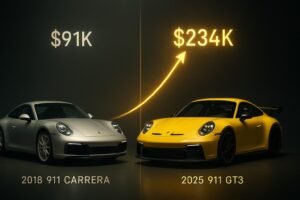
A 2018 Porsche 911 Carrera started at $91,000. By mid-2025, that same car costs $134,650—a 48% jump in seven years. What was once an aspirational sports car has become a case study in luxury price inflation gone wild (or as we like to say, Porsche 911 price inflation).
The 911’s escalating sticker shock isn’t just about materials and engineering. It’s about what happens when post-pandemic economics, dealer practices, and speculative fever collide with a storied nameplate. Here’s what’s really driving the price spiral—and whether it can last.
From Premium to Stratospheric: The Numbers Tell the Story
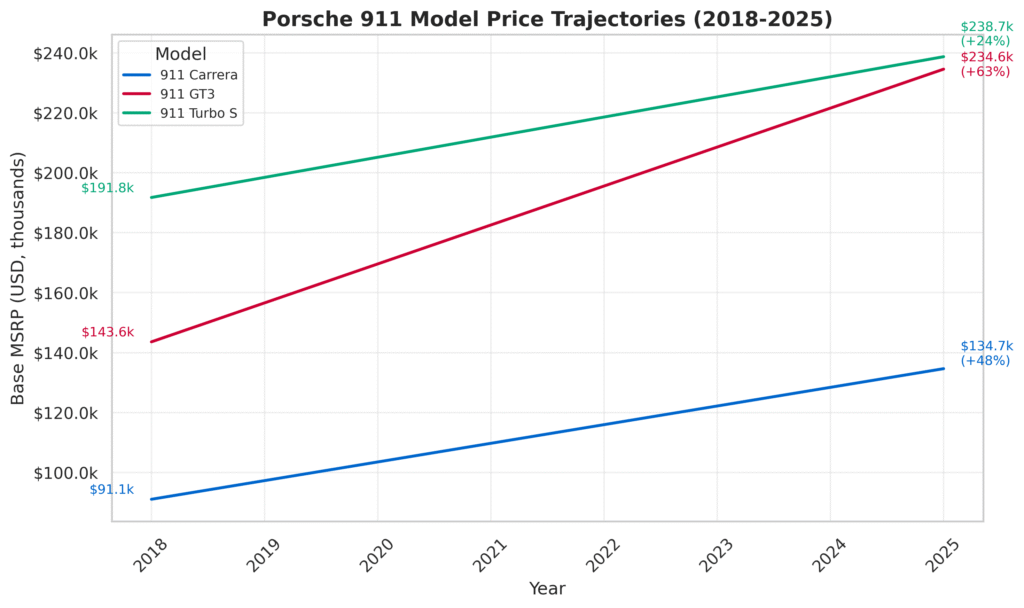
The base 911 Carrera’s trajectory shows how quickly “accessible luxury” became something else entirely. In 2018, Porsche positioned the Carrera at roughly $91,000 MSRP—premium, certainly, but within reach for successful professionals saving for their dream car. By 2024, successive price hikes pushed that figure past $120,000. Then came 2025: two separate increases in four months, driven first by model-year updates and then by what Porsche euphemistically called “market conditions,” lifted the base price above $130,000, including destination fees.
The GT3—Porsche’s track-focused naturally aspirated masterpiece—suffered an even more dramatic fate. From roughly $144,000 in 2018, it climbed to $234,550 by 2025. That’s a $90,000 increase, or 63%, in less than a decade. The 2025 refresh alone added $40,000 to the sticker compared to the 2024 model, despite minimal mechanical changes beyond emissions compliance tweaks.
At the top, the flagship 911 Turbo S crossed a psychological threshold. What cost around $191,000 in 2018 now starts at approximately $241,000—placing it squarely in supercar territory alongside Lamborghini Huracáns and Ferrari F8s. A quarter-million dollars for a 911, once unthinkable, has become the new baseline for Porsche’s ultimate daily-driver sports car.
These aren’t inflation-adjusted figures keeping pace with the economy. U.S. inflation from 2018 to 2025 totaled roughly 28%. The 911 Carrera’s 48% increase outpaced that by a factor of nearly two. Something beyond normal cost pressures was at work.
The Hidden Premium: When Sticker Price Is Just the Starting Bid
MSRP inflation tells only half the story. The other half unfolds at dealerships, where Additional Dealer Markups (ADMs) transformed list prices into opening negotiations rather than final numbers.
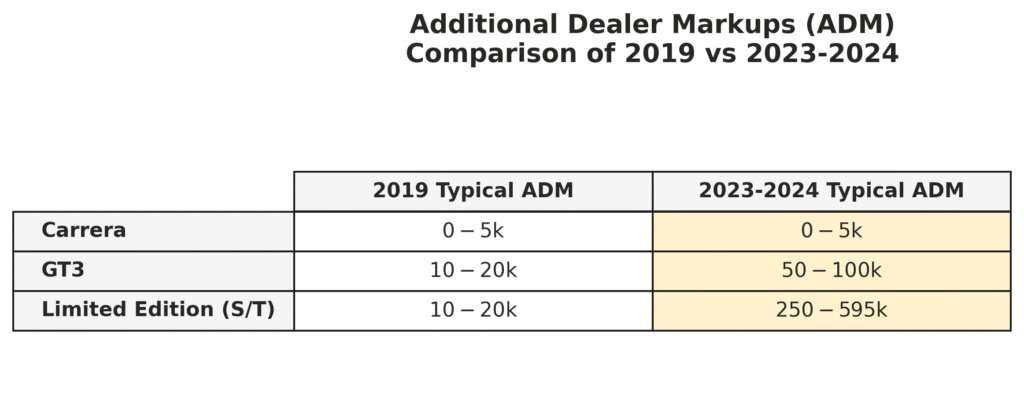
Before 2020, markups existed but remained modest. A base Carrera typically sold at or near sticker. Limited models like the GT3 commanded premiums—$10,000 to $20,000 was standard, with $50,000 considered outrageous. Loyal customers with purchase histories often secured allocations at MSRP.
The pandemic rewrote those rules. By 2022-2023, $50,000 markups became routine. The truly desirable variants—GT3, GT3 RS, limited editions—regularly carried $75,000 to $100,000 premiums. In mid-2023, dealers openly advertised GT3 Touring allocations at $75,000 over MSRP, take it or leave it. The ultra-limited 911 S/T, with its $290,000 factory price, saw dealer asks of $200,000 to $250,000 above sticker, pushing all-in costs toward half a million dollars.
Why the explosion? Porsche’s allocation model creates artificial scarcity. The factory strictly limits production of GT and Turbo models, distributing them to dealers based on sales volume and loyalty metrics. Demand perpetually outstrips supply. During the pandemic wealth boom, affluent buyers flush with stimulus-boosted portfolios and crypto gains competed for access. Dealers, holding all the cards, extracted what the market would bear.
The geography of markups matters. Southern California, Miami, and New York—regions dense with wealth—saw the highest premiums. A GT3 allocation in Pasadena might carry a $100,000 markup while the same car in a smaller market commanded $40,000 over. The dealer’s leverage determined the toll.
Porsche’s attempts to curb speculation—like the one-year mandatory lease on S/T allocations—only shifted who profited. Cars hit the resale market at huge premiums after the lease period, benefiting dealers and flippers rather than the factory. By late 2024, Porsche itself began recapturing this margin by raising MSRPs, essentially charging closer to what buyers were already paying. A Porsche spokesperson told Road & Track that mid-2025’s price hikes were “absolutely necessary” given market conditions—a tacit acknowledgment that if customers will pay $200,000 for a GT3, Porsche wanted its cut rather than leaving it for dealers.
What Drove the Porsche 911 Price Inflation Frenzy: Economics Beyond Supply and Demand
Three forces converged to supercharge 911 prices beyond simple scarcity.
The wealth effect. The pandemic era minted millionaires. Zero-percent interest rates, surging equity markets, and cryptocurrency booms created a cohort of buyers for whom a $200,000 car was discretionary spending. Governments pumped stimulus while markets doubled the wealth of top earners. Luxury goods track stock portfolios closely, and with travel curtailed, high-net-worth individuals redirected spending toward tangible assets. A UK analysis attributed a 9.2% jump in luxury car registrations partly to “windfalls from cryptocurrency” creating overnight millionaires buying Bentleys, Maseratis—and Porsches.
Asset mentality. The 911, especially GT models, morphed from sports car to speculative asset. With inflation eroding cash and borrowing cheap, limited-edition Porsches became stores of value. Social media amplified this. Every Bring a Trailer auction result—like a 2022 GT3 with a $208,000 sticker selling for $241,000—validated the investment thesis. Fear of missing out drove buyers to act fast, anticipating further appreciation. The GT3’s naturally aspirated engine added urgency: these could be the last “analog” 911s before electrification, potential future classics worth more than purchase price.
Bottlenecks and scarcity. Supply-side disruptions during 2020-2022—chip shortages, logistics chaos—kept production below demand. Porsche deliberately limits GT volume to preserve exclusivity, but the pandemic’s wealth boom expanded the buyer pool faster than factory capacity. By the time production normalized, waitlists stretched years. Even used 911s appreciated during 2021-2022, an almost unprecedented inversion of depreciation curves.
Porsche’s Reckoning: When the Model Breaks
In July 2025, Porsche CEO Oliver Blume sent a stark message to employees: the company’s business model “no longer works in its current form.” The leaked memo warned that declining China sales (down 42%), costly EV development delays, and market volatility were hitting hard. Despite record North American deliveries, Porsche’s quarterly earnings plunged 91%, with revenue falling 13%.
The pricing strategy contributed. Porsche assumed brand cachet could support unlimited increases, only to discover even wealthy customers have limits. China balked at import premiums while local EV makers undercut pricing. In the U.S., where demand held, Porsche implemented two price hikes in four months during 2025—totaling 3.6% increases on the 911 line—citing tariffs and costs. A spokesperson justified the moves as necessary to maintain margins, but the rapid-fire adjustments suggested a company scrambling to protect profitability as the post-pandemic sugar high faded.
Internally, the debate likely centers on sustainability. Short-term, the 911 remains a profit engine. Long-term, alienating enthusiasts risks the brand’s core appeal. Forum discussions reveal frustration: buyers comparing $190,000 optioned Carreras unfavorably to Corvette Z06s or used Ferraris, questioning whether Porsche has priced itself into irrelevance for the next generation.
The incoming CEO, Michael Leiters—formerly of Ferrari and McLaren—signals potential reform. Ferrari’s model of strict supply control, direct client relationships, and deterring dealer gouging maintains high margins without eroding goodwill. Porsche might adopt similar tactics: auctioning allocations directly, expanding factory customization options to capture margin, or penalizing dealers with egregious markups.
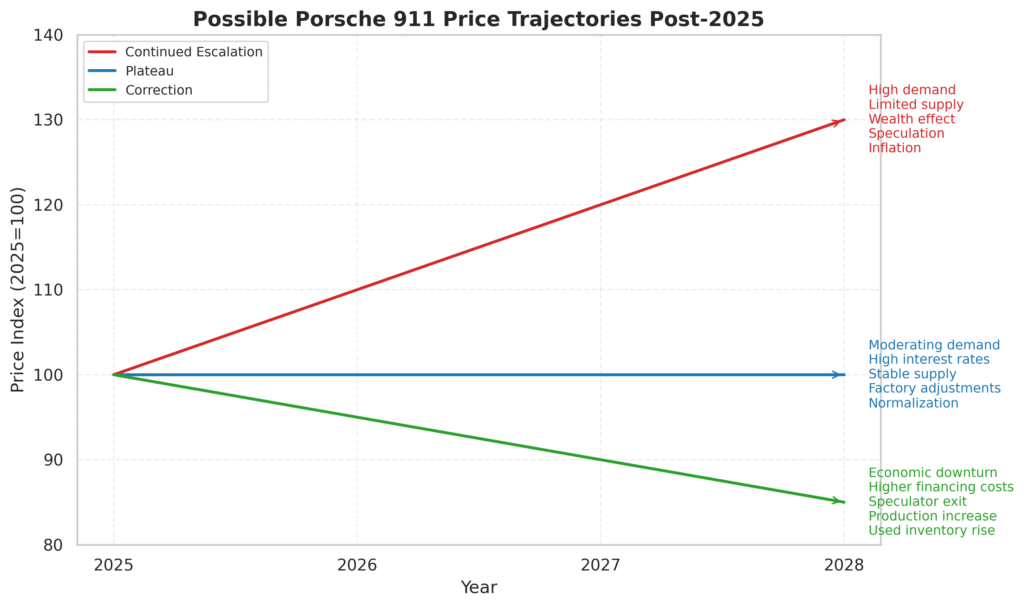
What Comes Next: Plateau or Correction?
The era of wild escalation appears to be tapering. Rising interest rates—7-8% APR versus pandemic-era 2%—make financing $200,000 cars less attractive. Tech layoffs, crypto downturns, and economic uncertainty have begun trimming the marginal buyer pool. In 2024, the used 911 market saw its first notable decline in years, with 992 Carreras dropping 8.5% before bouncing back in early 2025 on tariff fears.
Dealer markups show signs of softening. By late 2025, some stores quietly reduced GT3 premiums from $100,000 to $40,000-$50,000. Nearly-new GT3s failed to sell at $250,000 asking prices on enthusiast auction sites, suggesting speculator demand has cooled. If the broader economy stumbles, a 10-20% correction in 911 values seems plausible as flippers exit.
Porsche’s response will shape the outcome. The company could modestly increase GT production to meet demand without flooding the market. It might tighten dealer policies, prioritizing allocations to stores that sell at MSRP and end-users rather than brokers. Expanding ultra-expensive factory options—Paint to Sample, Heritage Design packages, Exclusive Manufaktur customizations—allows Porsche to legitimately raise MSRPs and capture margin that otherwise flows to dealers.
The hybrid 911, expected in the next generation, presents both opportunity and risk. It could justify higher pricing while appealing to emissions-constrained markets. But 911 buyers remain skeptical of electrification. Porsche’s backpedaling on EV targets—dropping its 2030 goal as “not realistic” and extending combustion models—acknowledges this tension.
Most analysts expect a plateau rather than crash. The 911 may simply stabilize at these elevated levels as the new normal. Porsche appears to have redefined the car as a luxury good for the few, not the aspirational many. Whether today’s $135,000 Carrera inches toward $150,000 or holds steady depends on macroeconomic winds and whether Porsche prioritizes volume or exclusivity.
The Bigger Picture
The Porsche 911 price inflation explosion reveals what happens when economic exuberance meets a storied brand with constrained supply. It’s a microcosm of luxury asset inflation during an era when the wealthy got dramatically wealthier and tangible goods became investment vehicles.
For enthusiasts who dreamed of 911 ownership, the window has closed. What was attainable for a successful professional in 2018 now requires wealth-class income. Porsche’s challenge: preserving the mystique that drives demand without becoming so exclusive it loses cultural relevance.
The 911 remains automotive royalty—60 years of engineering excellence and racing heritage. But its transformation from “everyday sports car” to speculative asset costing half what supercars did a decade ago marks a fundamental shift. Whether that shift proves sustainable or unsustainable will unfold over the next few years as economic reality, delayed by pandemic distortions, finally catches up.
One thing is certain: the days of a $90,000 base 911 are gone. Whether they return depends on forces far larger than Zuffenhausen can control alone—the same forces that sent prices spiraling in the first place.
References:
- Cars.com – “2018 Porsche 911 Specs and Pricing” (2018) – Available at: https://www.cars.com/research/porsche-911-2018/
- Car and Driver – “Porsche Hikes Prices Second Time in Four Months” (July 2025) – Available at: https://www.caranddriver.com/news/a65402532/porsche-hikes-prices-second-time-in-four-months/
- Motor1 – “Porsche Warns Employees The Business Model ‘No Longer Works'” (July 2025) – Available at: https://www.motor1.com/news/766814/porsche-business-model-no-longer-works/
- Business Insider – “Ultra-Luxury Car Brands Boomed in 2021 As Rich Got Richer” (January 2022) – Available at: https://www.businessinsider.com/rolls-royce-car-sales-boom-2021-pandemic-bentley-rolls-royce-2022-1
- UHY Hacker Young – “UK Luxury Car Ownership Up 9.2% as Crypto Investors Spend Wealth” (2021) – Available at: https://www.uhy-uk.com/insights/uk-luxury-car-ownership-92-241000-crypto-investors-spend-wealth
- Autoevolution – “Porsche 911 Range Hit With Major Price Increases” (July 2025) – Available at: https://www.autoevolution.com/news/porsche-911-range-hit-with-major-price-increases-in-the-united-states-254525.html
- OctoClassic – “Porsche 911 Carrera Prices Surge After Historic Decline” (2025) – Available at: https://octoclassic.com/blog/porsche-911-carrera-prices-surge-after-historic-decline
- Reuters – “Porsche’s New CEO Will Inherit Old Problems” (October 2025) – Available at: https://www.reuters.com/business/finance/porsches-new-ceo-will-inherit-old-problems-2025-10-24/