

Most people dismiss a single percentage point of inflation as negligible—a rounding error in the grand scheme of their financial planning. After all, what’s the difference between 2% and 3% inflation?
As it turns out, that “tiny” difference could cost you hundreds of thousands of dollars in purchasing power over a typical working career.
This isn’t fear-mongering or clickbait economics. It’s a mathematical reality that every investor, saver, and retirement planner needs to understand. The impact of inflation on retirement savings is one of the most underestimated financial risks facing Americans today, yet it rarely gets the attention it deserves in personal finance discussions.
Let’s break down exactly how this works—and why you should care deeply about every fraction of a percentage point when it comes to inflation.
Understanding Real vs. Nominal Returns
Before diving into the numbers, it’s crucial to understand one of the most misunderstood concepts in personal finance: the difference between nominal wealth and real wealth.
Nominal wealth is the dollar figure printed on your account statement. It’s the headline number—the one that feels reassuring or terrifying when you log into your retirement account. If your balance reads $5.4 million, that’s your nominal wealth.
But nominal wealth has a problem: it ignores what those dollars can actually buy.
Real wealth is your purchasing power. It’s how much housing, healthcare, travel, food, and time that money can actually afford in the future. Once inflation enters the picture, that $5.4 million stops being a promise—and starts becoming a question.
Investment returns work the same way.
A nominal return is the growth rate your portfolio shows on paper—say, 10% per year. A real return is what’s left after inflation quietly takes its cut. If inflation runs at 3%, your real return isn’t 10%—it’s closer to 7%.
That gap may feel small. Over decades, it’s devastating.
This distinction becomes critical when planning for retirement because inflation compounds in the background—slowly, invisibly, and relentlessly. Your account balance can rise every year while your future lifestyle quietly shrinks.
By the time inflation shows up in your retirement, it’s already done most of the damage.
The Case Study of Inflation Impact: Meet John
Let’s ground this discussion in a realistic, boring—in other words, successful—retirement scenario.
John is 30 years old. He isn’t chasing meme stocks or swinging for the fences. He commits to a simple plan: invest $20,000 every year until age 65. His portfolio earns an average 10% annual return, roughly in line with long-term market performance from a diversified portfolio.
There’s nothing extraordinary about John. That’s the point.
Over 35 years, John personally contributes:
-
$700,000
(That’s $20,000 per year × 35 years.)
Everything else comes from compounding.
By the time John turns 65, his retirement account grows to approximately $5.44 million. Of that total:
-
$700,000 is money John actually deposited
-
Nearly $4.7 million is generated purely by investment growth stacking on itself year after year
This is the quiet miracle of compounding. Most of John’s wealth doesn’t come from saving harder—it comes from time and consistent returns doing the work for him.
On paper, John is a multi-millionaire. His account statement signals security, comfort, and freedom.
But that headline number hides a critical vulnerability—one that inflation exploits mercilessly.
That’s where the real story begins.
Scenario 1: The Federal Reserve Hits Its 2% Inflation Target
The Federal Reserve has maintained a 2% inflation target for decades. This is considered the “goldilocks” inflation rate—not too hot, not too cold—that supports economic growth without eroding purchasing power too quickly.
Let’s calculate John’s real purchasing power if inflation averages exactly 2% for those 35 years.
To find real purchasing power, we discount the nominal amount by the cumulative inflation over the period. The formula is straightforward: Real Value equals Nominal Value divided by 1 plus the inflation rate, raised to the power of years.
When we run the numbers, John’s $5,442,000 divided by 1.02 raised to the 35th power equals approximately $2,720,000 in today’s dollars.
In other words, John’s $5.4 million nest egg would have the purchasing power equivalent to $2.7 million in today’s economy. That’s still substantial—enough for a comfortable retirement with proper planning.
The impact of inflation on retirement savings at 2% is significant but manageable. John loses roughly half his nominal value to inflation, but retains meaningful purchasing power.
Scenario 2: Inflation Averages 3% Instead
Now let’s examine what happens when inflation runs just one percentage point higher at 3% annually—a scenario that’s not hypothetical but has occurred during various periods in U.S. economic history, including recently.
Using the same formula with 3% inflation, John’s $5,442,000 divided by 1.03 raised to the 35th power equals approximately $1,936,000 in today’s dollars. John’s purchasing power drops to $1.9 million in today’s dollars.
Let’s put these scenarios side by side. With the Fed’s 2% target, John has $2,720,000 in real purchasing power. With 3% inflation, he has $1,936,000. That single percentage point of additional inflation destroyed $784,000 in purchasing power.
Think about that for a moment. John did everything right. He started saving early, contributed consistently for 35 years, achieved strong investment returns, and never touched his retirement savings.
Yet forces completely outside his control—monetary policy, government spending, supply chain disruptions, energy prices—silently confiscated nearly $800,000 of his wealth.
This is the true impact of inflation on retirement savings that financial advisors often gloss over with generic warnings about “maintaining purchasing power.”
Breaking Down the 30% Lifestyle Reduction
The $784,000 difference represents a 28.8% reduction in purchasing power, essentially 30% less. But what does this actually mean for John’s retirement lifestyle?
When it comes to healthcare costs, the numbers are sobering. At today’s prices, the average couple retiring at 65 will need approximately $315,000 for healthcare expenses throughout retirement.[1] With 30% less purchasing power, John faces difficult choices about healthcare quality, supplemental coverage, or out-of-pocket exposure.
Consider housing and living expenses. A retirement budget of $90,000 per year—comfortable but not extravagant—requires $2.7 million at a 3.33% safe withdrawal rate. John can afford this at 2% inflation. At 3% inflation, his $1.9M is nearly $800,ooo short, forcing him to make tough decisions.
He must either reduce annual spending to approximately $64,000, which represents a 29% lifestyle cut, accept higher portfolio risk by increasing withdrawal rates, or work several additional years to compensate for the shortfall.
Many retirees budget $10,000 to $15,000 annually for travel during their active retirement years from ages 65 to 75. The $784,000 shortfall eliminates approximately 52 to 78 years’ worth of this discretionary spending—essentially the difference between traveling the world and staying home.
For those hoping to leave an inheritance or support causes they care about, the impact of inflation on retirement savings at this magnitude can completely eliminate legacy plans. That $784,000 could have provided down payments for multiple grandchildren’s homes, funded endowed scholarships, enabled substantial charitable contributions, or provided financial security for the next generation.
The 30% reduction isn’t just about numbers. It’s about decades of retirement experiences, security, dignity, and generosity that simply vanish due to monetary policy outcomes.
Historical Context: When Has Inflation Exceeded 3%?
Understanding the impact of inflation on retirement savings requires acknowledging that 3%+ inflation isn’t merely theoretical—it’s historical fact and recent reality.
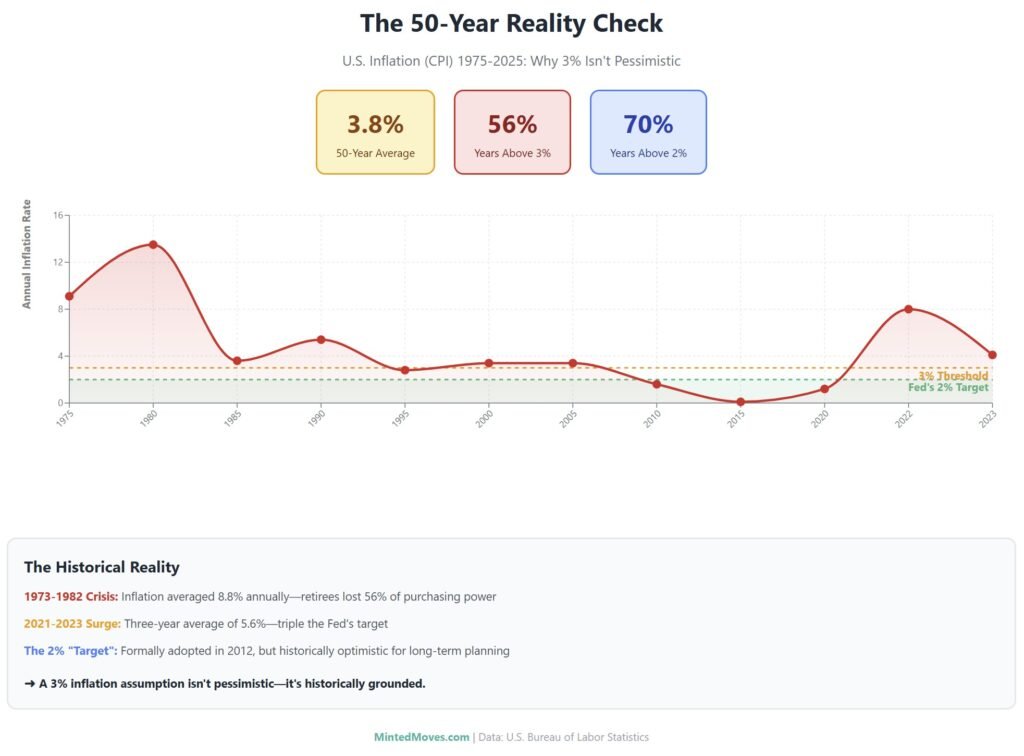
From 1973 to 1982, U.S. inflation averaged 8.8% annually, with several years exceeding 10%.[2] Retirees during this period saw their purchasing power devastated. A $100,000 nest egg in 1973 had the purchasing power of just $44,000 by 1982—a 56% loss in less than a decade.
Those who retired in 1970 with what seemed like adequate savings found themselves scrambling by 1980, with many forced back into the workforce.
More recently, inflation surged following pandemic-era monetary and fiscal stimulus. In 2021, inflation reached 4.7%. In 2022, it spiked to 8.0%. And in 2023, it remained elevated at 4.1%.[3]
This three-year burst averaged 5.6% annually—nearly triple the Fed’s target. Anyone who retired in 2020 has already experienced a 16% cumulative loss in purchasing power, with compound effects that will echo through their entire retirement.
It’s also worth putting the Federal Reserve’s inflation target into proper historical context. The Fed did not formally adopt a 2% inflation target until 2012, and that target is defined using PCE inflation, not the CPI most households actually experience.[5] Over longer time horizons, inflation has not clustered neatly around 2%. Using CPI-style measures, average U.S. inflation over the past 50 years has been closer to 3.8%.[6]
In other words, treating 2% inflation as a long-run baseline may be optimistic for retirement planning. A 3% assumption isn’t pessimistic—it’s a historically grounded stress test. And as our case study shows, that seemingly small difference can reshape a retirement.
How Inflation Changes the Rules of Retirement
Once inflation enters the picture, retirement planning stops being about hitting a single number and starts becoming a tradeoff problem.
There are only a few levers that actually matter. Inflation doesn’t eliminate them — it makes them more expensive to pull.
1. Inflation Breaks Traditional Portfolio Assumptions
Many retirement plans quietly assume that a traditional 60/40 portfolio—60% stocks, 40% bonds—will behave as it has in the past. Inflation disrupts that balance.
Bonds, by design, struggle in inflationary environments because their payments are fixed while prices rise. Equities offer some protection, but only companies with pricing power can consistently pass higher costs on to customers. Others see margins compress.
Assets that reprice with inflation—such as real estate, commodities, and inflation-linked securities—behave differently under sustained price pressure. The takeaway isn’t that any single asset “solves” inflation. It’s that inflation changes correlations investors often take for granted.
Planning as if yesterday’s asset behavior will hold tomorrow is one of the quiet risks inflation introduces.
2. Inflation Raises the Cost of Doing Nothing
Inflation doesn’t just shrink future purchasing power — it raises the price of inaction.
In our case study, maintaining the same retirement lifestyle at 3% inflation instead of 2% requires roughly 30% higher annual savings. That isn’t a judgment. It’s arithmetic.
There are only three ways to absorb that gap:
-
Save more
-
Spend less
-
Work longer
Inflation doesn’t care which lever you pull. It simply forces the choice.
3. Withdrawal Rates Become Less Forgiving
Much of retirement planning relies on withdrawal-rate rules of thumb built during periods of relatively stable inflation.
Higher inflation compresses those margins.
Starting withdrawals become more conservative. Spending becomes more variable. Cash buffers grow larger. Flexibility becomes more valuable than optimization.
Inflation turns retirement from a static plan into a dynamic system, where adjustments aren’t optional — they’re ongoing.
4. Time Becomes the Most Powerful Hedge
One of the few forces that reliably offsets inflation is time spent working.
Each additional year of work delivers three compounding benefits:
-
Another year of contributions
-
One less year of withdrawals
-
A shorter retirement horizon overall
Even modest delays can meaningfully improve retirement resilience. In an inflationary environment, time often does more heavy lifting than portfolio tweaks.
5. Inflation Rewards Income Designed to Survive It
One of the rare income streams explicitly built to handle inflation is Social Security, which includes automatic cost-of-living adjustments.
Delaying benefits increases payments substantially, creating a larger base of inflation-adjusted income [4]. In a high-inflation world, guaranteed purchasing power becomes disproportionately valuable — not because it maximizes returns, but because it stabilizes outcomes.
Inflation doesn’t just threaten portfolios. It exposes the value of income streams that don’t rely on market assumptions.
The Bigger Picture
The lesson isn’t that retirement is impossible under inflation.
It’s that inflation quietly rewrites the rules:
-
It punishes rigidity
-
It rewards flexibility
-
It turns “good enough” plans into fragile ones
Inflation doesn’t announce itself as a crisis. It shows up as fewer options, tighter margins, and delayed decisions — decades after the damage is done.
That’s why planning for inflation isn’t about pessimism.
It’s about realism.
Conclusion: Inflation Is the Silent Retirement Killer
John’s story illustrates a sobering reality. Even doing everything “right” in your retirement planning may not be enough if inflation runs higher than expected. The impact of inflation on retirement savings represents one of the largest, least-controllable risks to long-term financial security.
The $800,000 difference between 2% and 3% inflation over 35 years isn’t just a number. It’s the difference between generous retirement living and careful rationing, and between leaving a legacy and leaving nothing.
Here are the key takeaways. First, inflation compounds silently but devastatingly over decades. Second, small differences in inflation rates produce massive differences in outcomes. Third, nominal account values are misleading—purchasing power is what matters. Fourth, historical inflation has frequently exceeded the Fed’s 2% target. And fifth, protecting against inflation requires deliberate portfolio construction and planning.
Inflation isn’t just a headline about rising prices at the grocery store or gas pump. It’s a hidden tax that compounds relentlessly, and potentially the largest threat to your retirement security.
The impact of inflation on retirement savings demands your attention now—because by the time you reach retirement, it’s too late to course-correct.
Your future self, the one trying to retire comfortably despite decades of inflation, will thank you for taking action today.
References
[1] Fidelity Realty Magellan – Healthcare costs in retirement estimate – Available at: https://www.fidelity.com/viewpoints/personal-finance/plan-for-rising-health-care-costs
[2] U.S. Bureau of Labor Statistics – Historical Consumer Price Index data (1973-1982) – Available at: https://www.bls.gov/cpi/
[3] U.S. Bureau of Labor Statistics – Recent inflation data (2021-2023) – Available at: https://www.bls.gov/cpi/
[4] Social Security Administration – Delayed retirement credits and benefit calculations – Available at: https://www.ssa.gov/benefits/retirement/planner/delayret.html
[5] Federal Reserve Board – Statement on Longer-Run Goals and Monetary Policy Strategy (January 2012) – Available at: https://www.federalreserve.gov/monetarypolicy/files/FOMC_LongerRunGoals.pdf
[6] World Bank – Inflation, consumer prices (annual %), United States – Available at: https://data.worldbank.org/indicator/FP.CPI.TOTL.ZG?locations=US